
Selected SEEP Master’s Theses
TALENTA Awarded SEEP Theses
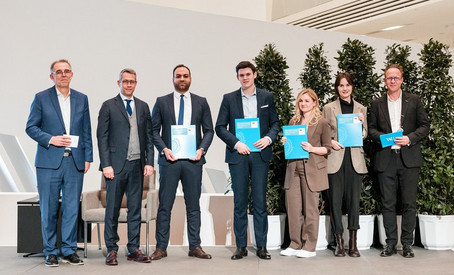
For many years, WU has been awarding the TALENTA prize to the authors of the most outstanding academic theses of the year. The award winners receive a certificate and a cash prize provided by the City of Vienna. Each year, a jury selects the three top bachelor’s and master’s theses from all nominations.
We are very proud that in 2021, 2022, 2023, 2024 and 2026 a SEEP student’s thesis was selected for this prestigious award! Here is information about SEEP's recent TALENTA winners:
Paul Höfle, TALENTA Award Recipient 2026, SEEP Cohort 12
Shaping elderly living, together: The role of elderly co-housing
in the Viennese and Austrian housing landscapes
Elderly co-housing is a relatively novel innovative form of elderly housing, which is practiced in Vienna in a variety of institutional forms. In this thesis, bottom-up co-housing projects organized by participants and institutionally coordinated elderly flat-shares are studied from an institutional economic perspective.
International literature shows that elderly co-housing, which covers both flat-shares as well as a range of related forms of community living for elderly people, is associated with a range of positive health effects, and supports agency in old age. Despite this, it remains a comparatively niche phenomenon in the Viennese housing landscape.
In keeping with the institutional frame of analysis, and because there is a lack of reliable data on elderly co-housing projects, qualitative expert interviews are chosen as the methodological basis due to the high specificity of information on project characteristics required for institutional analysis. Interviewees include bottom-up project organizers, people working for social institutional providers, and external experts from academia and local government.
A total of thirteen expert interviews were analysed via thematic analysis, supplemented with extensive triangulation of expert perspectives. The findings suggest a positive assessment towards many of the advantages of co-housing found in international literature being present in the Austrian iteration, and underlines the importance of agency in project governance. Real estate tenders (Bauträgerwettbewerbe) and developers were found to be important in structuring the possibilities of co-housing in Vienna, especially as projects usually depend on public funding. Some limits to direct scaling are identified, which helps explain their niche status. Translation of niche practices is evident, however, especially from bottom-up projects to institutional organizers. By investigating the institutional role elderly co-housing plays in supporting innovation in the elderly housing landscape, this thesis makes a novel contribution both to institutional studies of co-housing, as well as to literature on social contexts of ageing.
Current developments in the space are also explored: Agency in self governance is found to be an important priority for bottom-up projects when interacting with policymakers. While the tension between paternalist institutional logics and the drive to self-governance can limit direct adoption of the model, regulatory cooperation is also evident, which shows the relevance of legal innovation to diffusion. Additionally, institutional flat-share providers are actively developing their portfolios in Vienna, which underlines the relevance of knowledge sharing from bottom-up actors, and institutional networks. These processes are all found to facilitate the diffusion of niche innovations, which can in turn support more positive health- and wellbeing outcomes for elderly people.
Carl Frederick Luthin, TALENTA Award Recipient 2023, SEEP Cohort 8
EU Investment Protection Policy: Removing Barriers to Climate Policy under the European Green Deal?
The European Union and its Member States have acknowledged that international investment protection agreements (IIAs), such as the Energy Charter Treaty (ECT), hinder their decarbonisation efforts under the European Green Deal (EGD). Investor-state dispute settlement (ISDS) provisions in IIAs allow foreign investors to obstruct, weaken or delay policies of their host states that compromise the value of their investments.
This also applies to climate policies aiming to phase out fossil fuels. Hence, ISDS claims by foreign fossil fuel investors may critically weaken climate action. The European Commission and Germany, France, Spain, the Netherlands and Poland have understood this threat and drawn the conclusion to exit the ECT.
However, several hundreds of IIAs between the EU Members States and non-EU countries still pose a risk to climate action around the globe. Most actors in EU investment policy appear to be unaware of this risk, whereas reform options for the Member States’ bilateral investment treaties (BITs) are available.
In my Master thesis, I explored how actors in EU institutions assess the interaction between investment protection and climate policy and how they intend to further develop the EU’s investment protection policy. Based on a literature review, qualitative interviews and policy documents, I compared the policymakers’ assessments and positions to evaluations and reform options discussed in the academic literature.