
Teaching Skills Certificate | Prae Docs
The WU Teaching Skills Certificate Basic is designed for Praedocs and covers the mandatory training in teaching and pedagogy required under Section 49(7) of the Collective Agreement. The certificate program focuses on the fundamentals of university teaching that are relevant to planning and conducting courses. Over the course of nine in-person modules, participants gradually develop their own course design and explore their new role as lecturers.
The program addresses key questions of effective teaching:
How can learning objectives, methods, and assessment formats be effectively aligned?
How can digital elements be integrated?
Which methods are suitable for my course?
What are the framework conditions for teaching at WU?
At the end of the program, participants will present their teaching concept in the form of a poster.
The total time commitment is approximately 39 hours, including 30 hours of in-person instruction and 9 hours of self-study for the final development of the course concept and preparation for the “Designing Digital Teaching” module.
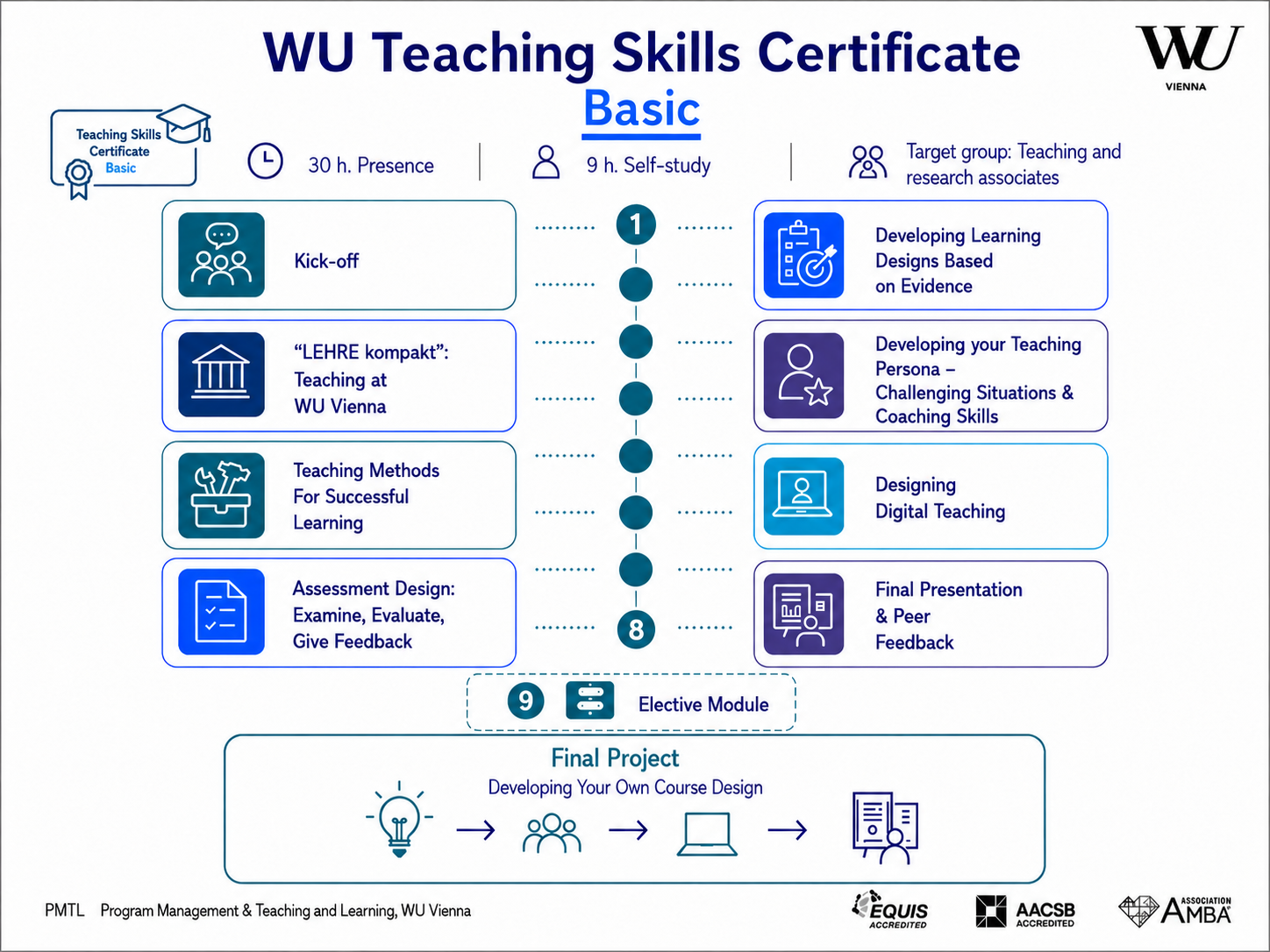
Schedule Overview (Mandatory Modules)
The required modules must be completed within one year. Participants must begin with the introductory module, and the program concludes with the final presentation. The required modules in between may be taken and completed in any order.
The elective module can be freely chosen from the options listed below and completed independently of the required modules.
Schedule of Mandatory Modules for the Winter Semester 2026/27 and the Summer Semester 2027
| Course Title | Winter Semester 2026/27 | Summer Semester 2027 |
|---|---|---|
| Course TitleKickoff | Winter Semester 2026/27 Date: September 16, 2026, 10:00 a.m.–12:30 p.m. Room: TC 4.12 Date: October 23, 2026, 9:30 a.m.–12:00 p.m. Room: LC 2.076 | Summer Semester 2027 Date: February 10, 2027, 9:30 a.m.–12:00 p.m. Room: D4 0.136 Date: February 25, 2027, 9:30 a.m.–12:00 p.m. Room: D4 0.136 |
| Course TitleDeveloping Learning Designs Based on Evidence | Winter Semester 2026/27 Date: October 16, 2026, 9:00–11:00 a.m. Room: TC 5.13 Date: December 1, 2026, 2:00–4:00 p.m. Room: TC 5.05 | Summer Semester 2027 Date: March 12, 2027, 10:00 a.m.–12:00 p.m. Room: TBD Date: May 5, 2027, 2:00–4:00 p.m. Room: TBD |
| Course Title"LEHRE kompakt": Teaching at WU Vienna | Winter Semester 2026/27 Date: October 6, 2026, 4:00–6:00 p.m. Room: TC 4.27 Date: November 19, 2026, 2:30–4:30 p.m. Room: EA 5.040 | Summer Semester 2027– |
| Course TitleAssessment Design: Examine, Evaluate, Give Feedback | Winter Semester 2026/27 Date: November 6, 2026, 9:00 a.m.–1:00 p.m. Room: LC 2.054 Date: January 20, 2027, 9:00 a.m.–1:00 p.m. Room: D4 0.136 | Summer Semester 2027 Date: April 20, 2027, 9:00 a.m.–1:00 p.m. Room: TBD Date: June 9, 2027, 9:00 a.m.–1:00 p.m. Room: TBD |
| Course TitleDeveloping Your Teaching Persona – Challenging Situations & Coaching Skills | Winter Semester 2026/27 Dates: December 10 & December 17, 2026 Room: AD Conference Room 1 (Dec. 10), AD Conference Room 2 (Dec. 17) Dates: February 9 & February 16, 2027 Room: AD Conference Room 1 (Feb. 9), AD Conference Room 2 (Feb. 16) | Summer Semester 2027 Dates: May 4 & May 11, 2027 Room: TBD Dates: July 8 & July 15, 2027 Room: TBD |
| Course TitleTeaching Methods for Successful Learning | Winter Semester 2026/27 Date: December 16, 2026 Room: TBD Date: January 26, 2027 Room: TBD | Summer Semester 2027 Date: April 15, 2027 Room: TBD Date: July 7, 2027 Room: TBD |
| Course TitleDesigning Digital Teaching | Winter Semester 2026/27 Date: October 15, 2026, 1:00–4:00 p.m. Room: TC 4.03 Date: December 10, 2026, 3:00–6:00 p.m. Room: D1 1.074 | Summer Semester 2027 Date: February 18, 2027, 9:00 a.m.–12:00 p.m. Room: TC 3.01 Date: April 27, 2027 Room: TBD |
| Course TitleFinal Presentation & Peer Feedback | Winter Semester 2026/27 Date: February 26, 2027, 9:30 a.m.–12:00 p.m. Room: D4 1.200 | Summer Semester 2027 Date: July 8, 2027, 9:30 a.m.–12:00 p.m. Room: D4 1.200 Date: July 16, 2027, 9:30 a.m.–12:00 p.m. Room: D4 1.200 Date: September 22, 2027, 9:30 a.m.–12:00 p.m. Room: D4 1.200 |
Registration for Mandatory Modules for the 2026/27 Academic Year
Academic Year 2026/27
|
Elective Module Offerings | Winter Semester 2026/27
| Skills | Date |
|---|---|
| Skills• Make presentation content more dynamic and interactive • Use ThingLink’s AI-powered features to create media content • Experience and create simple interactive learning paths | DateFri, Sept. 25 9:00 a.m.–12:00 p.m. |
Registration:
DigitalTeaching Services
| Skills | Date |
|---|---|
| Skills• Evaluate the pedagogical applications of digital escape rooms in teaching • Use gamification elements to convey content | DateThu, Jan. 21, 2027 9:00 a.m.–12:00 p.m. |
Registration:
Digital Teaching Services
| Skills | Deadline |
|---|---|
| Skills• Learn about media-based assignments as an alternative to traditional text-based assignments • Receive ideas and know-how on planning, production in the FLEX Media Studios, and integration into Canvas • Learn about assessment strategies for media-based assignments | DeadlineFri, Dec. 11 9:00 a.m.–12:00 p.m. |
Registration:
Digital Teaching Services
| Skills | Date |
|---|---|
| Skills• Learn about alternatives to the classic PowerPoint • Make presentations more interactive and visually connected • Compare the advantages and added value of the two tools | DateThu, Nov. 26 2:00–5:00 p.m. |
Registration:
Digital Teaching Services
| Skills | Date |
|---|---|
| Skills• Support students in using genKI in a reflective, responsible, and competent manner • Further develop valid and learning-objective-oriented assessment formats that incorporate AI • Analyze best practices for using AI in teaching and apply them to one’s own course | DateFri, Sept. 25 10:00 a.m.–12:00 p.m. TC 3.07 |
Registration:
Teaching and Learning Development
| Skills | Date |
|---|---|
| Skills• English as the Language of Instruction • Classroom Management • Student engagement | DateWed, Jan. 27, 2027 11:30 a.m.–2:00 p.m. |
Registration:
Personnel Development
| Skills | Appointment |
|---|---|
| Skills• Consciously using body language • Basic knowledge of voice work • Conducting conversations using body language and voice • Paying attention to physical and vocal resources during long class sessions | AppointmentMon., June 14 & 28, 2027 9:00 a.m.–3:00 p.m. |
Registration:
Personnel Development
Module Descriptions (Required Modules)
Kick-off
This module serves as an introduction to the program. It gives participants the opportunity to get to know one another and introduces them to the program’s goals and structure. Participants also identify a specific course design that they will develop step by step over the course of the program. They discuss quality criteria for course design and examine examples of successful academic posters.
Objectives
Participants…
… identify a specific course or teaching project that they would like to develop as part of the certificate program.
… are able to incorporate the requirements for developing a course design into their planning
… are familiar with quality criteria for academic posters and develop initial ideas for their own design
Contents
Introductions, objectives, program schedule;
Details on the “assignment”: Developing a course design over the course of the program
Designing scientific posters
Instructors: Dr. Johanna Warm, Katrin Bleckenwegner, MEd
Developing Learning Designs Based on Evidence
This module focuses on the systematic planning of courses based on the principle of constructive alignment. Participants will learn how to systematically align learning outcomes, teaching methods, and assessment. They will become familiar with the principle of scholarly teaching. In addition, they will formulate competency-based, measurable learning outcomes for their own course design and begin to consider possible teaching formats and assessment methods.
Objectives
Participants…
… can explain the principle of constructive alignment and apply it to their own course design
… understand what characterizes scholarly teaching and draw conclusions from this for their own course design
… can formulate competency-based learning outcomes for their own course design
Contents
Constructive Alignment, quality criteria for good teaching
Formulating competency-based learning outcomes
Scholarly Teaching & SoTL; Evaluation and Further Development of One’s Own Teaching
Course Instructors: Katrin Bleckenwegner, MEd; Florian Kellner, MSc; Dr. Aisha Tüchler; Mag. Thomas Sommerer, MA, PhD
"LEHRE kompakt": Teaching at WU Vienna
In LEHRE kompakt, participants explore the institutional framework for teaching at WU. They receive guidance on legal requirements (course formats, examination regulations with a focus on attendance policies and grading), as well as on classroom technology. In addition, WU guidelines are compared with participants’ own ideas for course design.
Objectives
Participants…
… will be familiar with the legal framework for teaching at WU
… can assess whether their own course design aligns with the course format, assessment method, and attendance policies
… identify ways in which classroom technology can support their course design
Contents
WU-Specific Aspects of Teaching:
Legal framework for teaching (especially course formats, examination regulations, attendance policies)
Classrooms and the technology available within them
Instructors: Claudia Böck, MA, Mag. Marlis Sobernig
Assessment Design: Examine, Evaluate, Give Feedback
Participants will develop the fundamentals of valid and fair performance assessment. They will learn about different types of assessments, how to distinguish between formative and summative assessments, and reflect on selection criteria. Particular emphasis is placed on the use of generative AI in the context of assessment and on critically reflecting on existing assessment practices. Participants will develop an assessment design for their own course.
Objectives
Participants…
… can distinguish between summative and formative assessment formats
… are familiar with different assessment formats and select appropriate formats for the learning outcomes in their course design
… can develop evaluation criteria and rubrics for their own course design
… can critically evaluate their own assessment design in terms of validity, fairness, assessment errors, and challenges posed by AI
Contents
The Role of Assessment in Constructive Alignment
Overview of assessment formats and selection criteria
AI as a challenge
Grading and Feedback (Criteria, Rubrics, Efficiency)
Instructor: Dr. Johanna Warm
Developing your Teaching Persona - Challenging Situations & Coaching Skills
In this module, Prae Docs have the opportunity to reflect on their role as educators, gain more confidence in their presentation, and develop strategies for typical teaching situations. Participants are supported in finding a teaching style that suits their subject area and personality.
Objectives
Upon completion of this module, participants will be able to...
… to reflect on and further develop their own role as educators.
… to present their subject matter confidently and authentically and to actively engage students.
… to professionally manage challenges and conflicts in the lecture hall.
… to make connections to their instructional design, including their teaching style and the chosen teaching formats and methods.
Contents
Teaching Personality & Attitude: Understanding one’s own role and developing a personal understanding of teaching.
Presence and Impact in the Classroom: Self-reflection and feedback on presence and impact in teaching.
Confidently Handling Challenging Situations & Students: Awareness of one’s own reactions and psychological strategies for dealing with student passivity, critical group dynamics, and unexpected disruptions.
Emotional Self-Management: Reflection on emotional patterns and tools for stress management.
Communication with Students: Understandinginterpersonal dynamics; examining one’s own communication style.
Integration & Application: Personal commitment and reflective questions regarding one’s own course design.
Instructor: Mag. Christine Hoffmann-Schütz
Teaching Methods for successful Learning
In this module, participants will learn about various university-level teaching formats and methods that they can apply in their own course design. The goal is to identify appropriate formats that align with both the course content and their own personality, and that support the defined learning objectives.
Objectives
Upon completion of this module, participants will be able to…
… to identify and implement various higher education teaching formats and methods appropriate to the learning outcomes and group size.
… to establish rapport with students within the first few minutes of the course.
… to facilitate group work.
… to use engaging methods for different group sizes.
… to design interactive teaching and learning formats.
Contents
Introduction to instructional formats and methods
The flow of a class and criteria for selecting methods.
“Warm Welcome Techniques” for establishing contact within the first 2 minutes.
“Holding the Room”—techniques for managing group dynamics.
Engaging methods for large and small groups.
Interactive teaching and learning formats.
Deepening understanding, reflection, and application of learning content.
Dealing with diversity: Taking into account different learning levels, languages, and backgrounds.
Deepening skills in handling challenging situations and students.
Instructor: MMag. Olivia Vrabl
Designing Digital Teaching
In this module, participants will become familiar with the Canvas learning platform and selected tools (e.g., Mentimeter and Mural) that they can use to digitally support and enrich their teaching. The module focuses on how to structure learning materials in Canvas to promote learning and how to present and assess partial achievements as assignments. In addition, participants will gain insights into digital tools for engaging students in in-person settings and explore ways to apply these tools in their own teaching.
This module takes place in a blended-learning format, meaning that participants complete assignments based on short video clips during a preliminary self-study phase (approx. 1 hour). This is followed by a 3-hour in-person workshop.
Objectives
Participants…
… will be able to present teaching materials in Canvas in a clear and structured manner.
… can map out course components in Canvas, communicate assessment criteria transparently, and support feedback processes.
… are familiar with the digital tools available at WU for engaging students and can make pedagogically sound decisions about how to use these tools in their own courses.
Contents
Using Canvas to Support Digital Teaching
Organizing Teaching Materials in the Canvas Environment
Administering and grading different types of assignments (individual and group work, media formats) in Canvas
Feedback options in Canvas and transparent grading
Using digital tools to engage students
Collecting and addressing student questions during a class
Conducting surveys (knowledge, opinion) and polls on a topic
Gathering and incorporating student feedback
Brainstorming in large and small groups
Final Presentation & Peer Feedback
Participants present the course designs they have developed in the form of posters. On these posters, they clearly explain their instructional decisions. As part of a “gallery walk,” they provide constructive feedback on their colleagues’ designs. A concluding reflection session serves to identify best practices and explore opportunities for applying them to future teaching.
Objectives
Participants…
… can justify their pedagogical decisions in a coherent and theoretically sound manner.
… can provide colleagues with criteria-based, constructive feedback
… reflect on their own development as educators and can derive next steps for their teaching practice from this reflection
Content
Providing criteria-based peer feedback
Identifying opportunities for application
Course Instructors: Dr. Johanna Warm, Katrin Bleckenwegner, MEd
Terms and Conditions & FAQs |
|---|
| Terms and Conditions & FAQsHere you’ll find all the information about the terms and conditions, as well as answers to frequently asked questions. Terms and Conditions & FAQs |
Information for Teachers
- Teaching Skills Certificate
- AI in teaching
- LEHRE kompakt workshops
- Teaching Coordination & Infrastructure
- Tutorial Programme
- Courses, Exams, and Theses
- Digital Teaching & Digital Exams
- Course Evaluation
- Payroll office for teaching staff
- Teaching Awards
- The Art of Teaching 2026
- Scholarship of Teaching and Learning