Isabella Grabner
Meet Our Researchers
Isabella Grabner
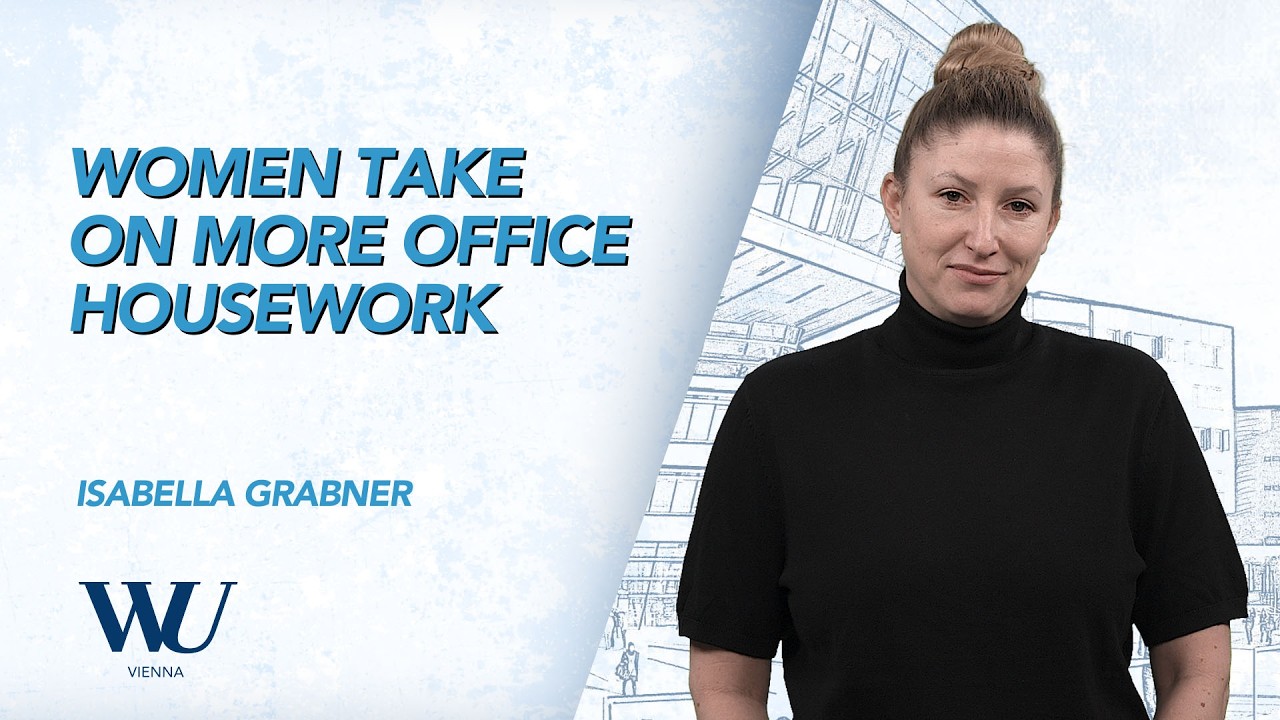
Isabella Grabner is a professor at the Institute for Strategic Management and Managerial Accounting at WU Vienna. In her current research, she examines how companies measure performance, how promotion decisions are made, and whether structural inequalities exist between women and men. After filming “Meet Our Researchers,” we visited her in her office to talk about the situation of women in the workplace, solidarity, and the role men play in creating equal opportunities.
How did you come up with your research topic?
My research focuses on how companies manage talent, how they assess performance, and how promotion decisions are made. Whenever we conduct empirical studies on these topics, we always analyze the data by gender. We typically find that the higher the hierarchical level, the fewer women are promoted – and the worse they perform in performance evaluation. As a result, the share of women decreases at each level of the career ladder. But this is not because women perform worse across all companies. We have to look more closely, because there are systemic differences in how the performance of women and men is evaluated.
How has the situation changed for women in the workplace?
Over the long term, a great deal has improved; open discrimination is rare nowadays. However, implicit biases still exist, and they are often harder to detect. Many companies believe they operate purely on merit, without any gender discrimination. But the criteria used for promotion still often favor men. It’s still valued, for example, when someone stays in the office until 10 pm and is always available. Women, who are more likely to have caring responsibilities than men, tend to perform worse on these measures. Structural inequalities like these are far more difficult to identify than explicit discrimination. When I brought up my recent study on “office housework” in conversations with my friends, who work in various industries, many said, “That’s me! In our company, too, no man has ever taken on these tasks.” So yes, a lot has improved – partly thanks to initiatives like pay transparency – but ultimately, it’s our entire society that needs to go the extra mile.
How can women support each other in their everyday working lives?
The most important thing is solidarity, simple as it sounds. Unfortunately, solidarity is often lacking. There’s the so‑called “queen bee phenomenon,” where women who had to fight really hard to climb the career ladder are less willing to support other women. Role models are also essential, not only CEOs, who may seem out of reach, but people who are approachable. A direct supervisor, for example, can be an example of how to balance family duties and a career, and they can openly address the challenges that come with it. The biggest obstacle to having more women in leadership positions is not a lack of capability, but a lack of confidence – often because they see too few relatable role models.
![[Translate to English:] Isabella Grabner](/fileadmin/wu/_processed_/9/f/csm_IMG_0121_26fba51fb3.jpg)
“There are systemic differences in how the performance of women and men is evaluated,“ explains Isabella Grabner.
What responsibility do men have in achieving gender equality?
Men play a crucial role in promoting equal opportunities, simply because they often hold more powerful positions. They must actively work to build diverse teams and question their own biases. But many men only begin reflecting on these issues when their own daughters enter the workforce and they witness inequalities firsthand. Men need to understand that it should not be a given that it’s always the women who take parental leave, even if they earn less.
You have a daughter yourself. What can parents do to help girls grow up confident and unconstrained by gender stereotypes?
There’s a saying that goes like this: “One of the most important decisions a woman makes is which man she chooses.” I can relate to that. After all, parents are the most important role models: In my own case, my husband took parental leave while I continued working. We both shared responsibilities, showing that anything is possible. From the very beginning, we took care to avoid gender stereotypes in raising our children. When it comes to children’s books, for instance, I make sure the characters aren’t stereotyped, say, as male firefighters and female nurses – and I often change the stories as I read them to my daughter. For Christmas, we gave her a toolbox. Of course, children will later be exposed to other influences as well, for example at school, but the foundation is laid at home.
What would you like the working world to look like for women by the time your daughter grows up?
I hope for a society where equal treatment is taken for granted and where performance is what matters, not gender. A world where we no longer need to discuss the gender pay gap or the leaky pipeline because these issues no longer exist. My wish is that one day my research will no longer be necessary.
![[Translate to English:] Puppenküche in Grabners Büro](/fileadmin/wu/_processed_/c/a/csm_IMG_0126_ea26b8dea1.jpg)
The play kitchen in Isabella Grabner’s office – her daughter uses it when she occasionally comes to work with her.
Reference related to the video
Bol, J. C., Fogel-Yaari, H., Grabner, I., Sedatole, K. (2026): Promoting Organizational Citizenship Behavior (OCB): Unintended Gender Disparities in the Participation and Evaluation of Different Types of OCB. In: The Accounting Review. 2026. 101 (1). Verfügbar unter SSRN: https://ssrn.com/abstract=5529958 oder DOI: 10.2308/TAR-2024-0149