
New study refutes traditional theories of executive risk-taking
NFL data and lab experiments show how psychosocial factors influence competitive decisions
When organizations perform worse than expected, traditional theories predict that they will respond by taking higher risks in an attempt to catch up. But if violent incidents happen nearby, things look completely differently and other mechanisms come into play.
A recent study carried out at WU Vienna University of Economics and Business shows that the corporate walls surrounding organizations are not impermeable to the effects of mass shootings and domestic terrorism: Such traumatic events trigger negative emotions in decision-makers and cause them to take a more security-oriented approach in responding to business shortfalls. This reduced willingness to take risks is particularly pronounced among executives who have long tenure in the affected community or are located close to where the incident occurred.
Traumatic violence changes management decisions
The authors of the study, Christian Schumacher (WU Vienna), Steffen Keck (University of Vienna), and Abhinav Gupta (University of Washington), show that common management theories usually portray decision-makers as largely rational actors who are detached from any emotions. At the same time, these theories often view the environments in which organizations operate in abstract terms, reducing them to markets and competitive conditions, without taking into account that companies are embedded in specific local communities where the impact of violent events is felt directly. The new study offers an alternative perspective by showing that strategic decisions are to a large extent shaped by affective states and emotionally charged incidents in the local community.
How emotions shape strategic priorities
In its theoretical underpinnings, the study ties in with the behavioral theory of the firm (BTOF): According to this theory, organizations tend to adopt riskier strategies when their performance is lacking, in an attempt to close the gap between the organization’s goals and its actual performance levels.
At the same time, the study also integrates regulatory focus theory. This approach distinguishes between promotion focus, which emphasizes opportunities, growth, and progress, and prevention focus, which emphasizes security, stability, and loss avoidance. Negative emotions, such as those experienced after violent incidents, typically shift the focus from promotion to prevention.
“Violent traumas such as mass shootings create precisely this kind of psychological shift,” explains study author Christian Schumacher. “Even when teams or companies are lagging behind, violent incidents reduce their tendency to make risky decisions in an attempt to catch up.”
Combining two perspectives on decision-making behavior
The study focuses on the question of how traumatic events in the community surrounding an organization affect the extent of risk-taking in the organization’s decisions. The researchers tested their hypotheses in two complementary studies:
Field study: The researchers analyzed nearly 40,000 fourth-down decisions in the US NFL between 2009 and 2018 and linked them to data on mass shootings and terrorist attacks. They found that in the aftermath of violent incidents that occurred within a 100-mile radius, significantly fewer risky decisions were made to make up for performance shortfalls.
Controlled lab experiments: Participants who were exposed to intense images of violent incidents were less likely to take risks in response to poor performance levels.
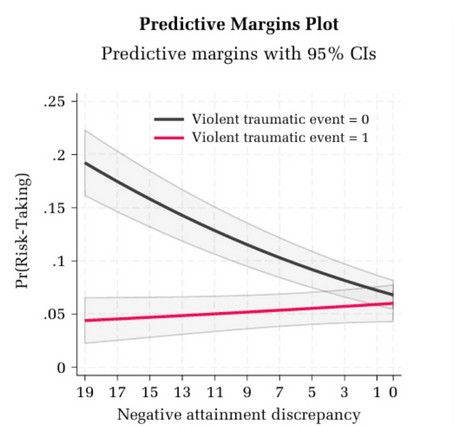
Graph: The graph shows the predicted probability of risky fourth-down attempts as a function of performance shortfalls – this probability is consistently lower in the aftermath of violent traumatic incidents.
Conclusions
The study shows that organizations are not machines – instead, they are embedded in specific social contexts. This means that violence in the public sphere generates economic and organizational consequences that go well beyond personal tragedies. Violent incidents have an impact on market strategies, competition, and leadership behavior, and they can influence strategic and competitive decision-making.
This also means that violence prevention, psychosocial support, and community stability are not only needed from a humanitarian perspective but also from an economic point of view.
Further Information
Schumacher, C., Keck, S., and Gupta, A., 2025. Violence and Competition: The Effect of Mass Shootings and Domestic Terrorism on Organizational Risk-Taking in Response to Performance Shortfalls. In: Academy of Management Journal 2025, in press.
Cyert, R. M., & March, J. G. 1963. A behavioral theory of the firm. Englewood Cliffs, NJ: Prentice Hall.
Lerner, J. S., & Keltner, D. 2001. Fear, anger, and risk. Journal of Personality and Social Psychology, 81(1): 146–159.
Morgeson, F. P., Mitchell, T. R., & Liu, D. 2015. Event system theory: An event-oriented approach to the organizational sciences. Academy of Management Review, 40: 515–537.
![[Translate to English:] Panorama von Wien mit Riesenrad](/fileadmin/wu/_processed_/a/3/csm_AdobeStock_268141837_bdd99a003b.jpeg)


![[Translate to English:] Vier Menschen sitzen stehen im Büro um einen Tisch](/fileadmin/wu/_processed_/e/1/csm_AdobeStock_1573041776_6ca085b1a1.jpeg)