![[Translate to English:]](/fileadmin/wu/_processed_/3/d/csm_103-Laptop-960_v1_9ca559ae50.jpg)
Characteristics of time use
Clara Himmelbauer, Yamna Krasny and Karin Heitzmann (2025)
In the research project “Characteristics of time use in the context of poverty, mobility, and intergenerational time use patterns,” we conducted detailed empirical analyses of the Austrian Time Use Survey 2021/22 and systematically linked this data source with a range of other data sets. In addition to the main topics of time poverty, mobility, and intergenerational time use patterns, we place a special focus on gender equality, and the distribution of time use between women and men.
The first focus of our project lies on time poverty, which is defined as a lack of free time. We empirically analyzed how people from different socioeconomic backgrounds are adversely affected by time poverty. In Austria, around 19% of the population aged 10 and above are at risk of time poverty, with women (20.6%) disproportionately affected. Other sociodemographic characteristics also play a role: middle-aged women are more often timepoor, while people aged 60 and over are hardly affected at all. Migration background, the number of people living in the household, and the age of the youngest child also increase the risk of time poverty.
By linking the Time Use Survey with data from EU-SILC, the Microcensus, and the Integrated Wage and Income Tax Statistics, the project also shows that time and income poverty often occur together. This multiple burden of both forms of poverty again affects women in particular. It also becomes clear that social inequalities often have an intersectional effect and can only be effectively addressed through integrated policy approaches.
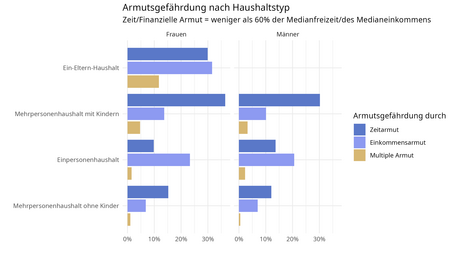
Risk of poverty by household type. Groups with fewer than 30 characteristics were excluded from the analysis
Legend: Around 30% of all women in single-parent households are at risk of time poverty alone. Slightly more than 30% are purely at risk of income poverty (household income). Just over 10% of all single mothers are at risk of both income and time poverty.
Data basis: Time Use Survey 2021/22, EU-SILC 2021 and 22.
Our second project focus lies on mobility patterns as revealed by time use surveys. We analyzed how much time different population groups spend on travel and how daily mobility differs according to gender, region, and degree of urbanization. The results show that women travel more on average than men (2.13 versus 1.95 trips per day) but spend a similar amount of time on mobility overall, as men's trips tend to be longer. Women also use public transport more often and walk more, while men use cars and bicycles more.
These gender-specific differences are also reflected in the purposes of the trips: women spend more time traveling in the context of care work, shopping, and administrative tasks, while men travel more in the context of their professional activities.
In addition, mobility behavior varies greatly depending by degree of urbanization. In urban areas, more journeys are made on foot and by public transport, while in rural areas the car dominates – relatively independently of the quality of public transport, as our analyses show. Despite these differences, it appears that the average time spent traveling hardly varies between urban and rural areas.
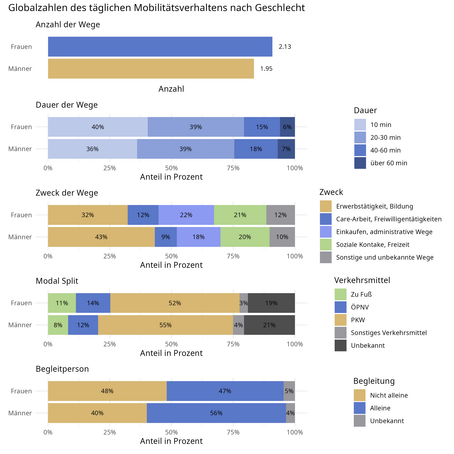
Number of journeys by gender, as well as duration, purpose, modal split and accompanying person for journeys by gender.
Legend: Women make an average of 2.13 journeys per day.
Data basis: Time use survey 2021/22.
The third central theme of the research project was the analysis of intergenerational time use patterns, in particular the relationship between the time use of parents and that of their children in the same household. The 2021/22 Time Use Survey offers the advantage that all household members aged ten and above are surveyed, which enables the analysis of parents' time use and its influence on their children's time.
Our results show that girls aged 10 to 19 already spend more time on care work and education, while boys have more leisure time. These differences increase with age, with boys also being more likely to be employed and less likely to participate in education and training.
Furthermore, we find evidence that parents' time poverty has an impact on the time use of children and adolescents. Children from households at risk of time poverty have, on average, less leisure time than their peers from households that are not time poor.
Finally, we analyzed the relationship between the amount of time children and adolescents spend on housework and the amount of time their parents spend on it. Our results provide evidence that children imitate their parents when it comes to spending time on housework—that is, if parents do more unpaid work, their children also take on more. This relationship is particularly pronounced between fathers and sons: the more housework fathers do, the more time sons spend on it as well.
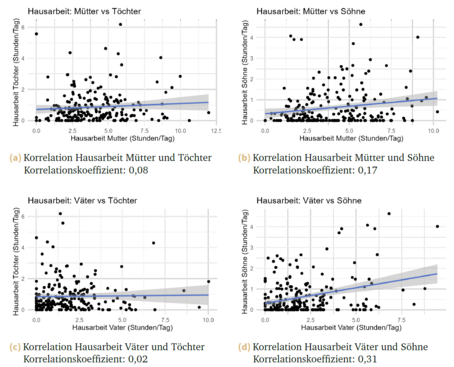
Correlation between the time spent on housework by parents and children in couple households with children aged between ten and 18.
Reading example: The strongest (positive) correlation between the time parents and children spend doing housework is between fathers and sons. If fathers do more housework, their sons tend to do the same.
Data basis: Time use survey 2021/22.
Overall, our project provides new insights that form a solid basis for relevant policy implications. Gender inequalities are particularly evident in time use in Austria. If a more equal distribution between the sexes is to be achieved, appropriate countermeasures must be taken and gender-equitable policies must be developed that promote a balanced distribution of workloads in the areas of paid work, care work, and housework. Political measures are necessary to reduce time stress and time poverty in general, not least because of the adverse health effects that can be associated with them. This applies to affected women and families in which care work plays a central role through childcare or caring for relatives in particular. Policy measures such as further expansion and promotion of high-quality institutional care for children and relatives in need of care could thus help to reduce the higher risk of women suffering from time poverty.
Contact
Clara HIMMELBAUER
E-Mail: clara.himmelbauer@wu.ac.at
MoreYamna KRASNY
Karin HEITZMANN
E-Mail: karin.heitzmann@wu.ac.at
more