![[Translate to English:] TC Gebäude](/fileadmin/wu/_processed_/d/7/csm_058-Laptop-960_v1_296fa1b956.jpg)
This is not waste
by OMV
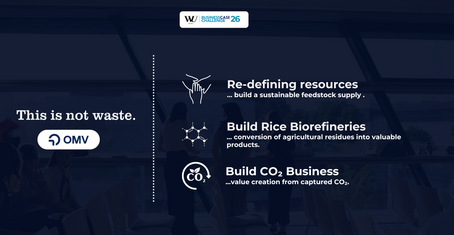
Welcome to the OMV Case

With the Business Case Challenge 2026, OMV, one of Austria’s largest industrial companies and a global Energy and Chemicals Group, invites students to help shape the transition toward a more sustainable future.
The energy and chemicals industry is undergoing fundamental transformation. While fossil resources still play a role in producing essential products, long-term competitiveness requires new approaches, such as circular feedstocks, renewable fuels, and carbon management solutions. OMV’s Strategy 2030 emphasizes sustainability and innovation across its business segments, from energy to fuels to chemicals solutions.
This year’s challenge is built around a single idea: “This is not waste – It is the start of something new.” Your task is to develop a business case that turns sustainability challenges into scalable, economically viable opportunities.
Case Summary
Teams can choose one of three independent topics. Each topic has its own context, business question, and deliverables. Your submission should propose a realistic initiative, explain why it fits OMV’s strategy, and quantify market potential, costs, and impact.
Option A
From Fossil to Sustainable Refinery: Opening New Feedstock Opportunities for OMV
Refineries of the future will rely less on fossil hydrocarbons and more on renewable hydrogen, captured carbon (CO₂), biomass, and recycled plastic waste. This shift creates a new upstream landscape, where securing sustainable feedstock supply becomes a strategic advantage.
Your challenge:
How can OMV build a robust, competitive, and sustainable feedstock supply for future refineries, leveraging one core upstream pathway (choose one):
CO₂, 2) biomass, or 3) plastic waste?
Deliverables (Option A):
Market Analysis: estimate market size, identify competitors, and assess geographical factors
Business Plan: propose a transformation idea and a convincing plan, with strong focus on logistics and setup
Financial and Ecological Cost-Benefit Analysis: quantify costs and resources needed from OMV and compare to potential financial and ecological gains
Option B
How to Develop a Rice Straw Biorefinery in Asia With Valorization of Side Products?
Rice straw is an abundant agricultural residue in Asia, often burned due to limited use. A biorefinery located close to harvest sites could convert rice straw into a bio-oil stream that can be upgraded in conventional refineries, supporting the shift toward higher-value fuels and chemical feedstocks. Economic viability depends on capturing and monetizing side streams like lignin and silica.
Your challenge:
Design a rice-straw biorefinery concept in Asia that converts waste into bio-oil while also valorizing side products to strengthen business viability and circularity.
Deliverables (Option B):
Market Analysis: estimate market size and identify competitors
Business Plan: develop a convincing plan aligned with OMV strategy, describing how OMV could build or partner into this opportunity
Financial and Ecological Cost-Benefit Analysis: quantify costs/resources and compare to financial and ecological gains, including volumes of output and side products
Option C
Molecules of the Future: Building Business Around CO₂ Capture, Storage and Utilization
Captured CO₂ will increasingly become a critical carbon source for low-carbon fuels and chemicals. However, the economics depend heavily on the full value chain, including capture type, transport infrastructure (pipeline, ship, truck), and access to storage and utilization hubs.
Your challenge:
Develop a business innovation that helps OMV build scalable business around carbon capture, storage, and utilization (CCS/CCU). Identify sources of CO₂, infrastructure prerequisites, and storage requirements, and propose a realistic business model for Europe.
Deliverables (Option C):
Market Analysis: market size, competitors, and prerequisites for a functioning CO₂ value chain in Europe
Business Plan: a convincing plan for OMV’s role, including analysis of CO₂ sources and storage needs
Financial and Ecological Cost-Benefit Analysis: quantify costs and resources needed from OMV and compare to potential financial and ecological gains
Bonus Option
Interdisciplinary Track: Double Your Chances of Winning (Optional)
You can choose to submit your case as an interdisciplinary team, combining business and economics skills with technical expertise (for example partnering with a student from a technical university). BCC provides a matchmaking option, and interdisciplinary submissions compete for additional prizes, effectively doubling your chances of winning.
Additional deliverables for interdisciplinary submissions (mark clearly in your presentation):
For Option A: Specify the technology pathway (focus on refinery processing) and estimate yields and conversion efficiencies
For Option B: Provide a technical concept for a rice straw biorefinery
For Option C: Provide a technical concept of the CO2 value chain
Evaluation Criteria
Persuasiveness of your business plan
Detail and quality of your analysis
Clarity of presentation and storyline
Structure of Your Submission (Presentation Chapters)
Introduction and Executive Summary
Idea Development
Market and Cost Estimation
Impact Assessment
Conclusion
Apply Now
Every successful business idea needs a clear strategy and a compelling business plan. That’s exactly what you can demonstrate at the Business Case Challenge 2026 – either individually or together with your team (max. 4 people per team).
Rules – What You Need to Know
Team size: You can participate individually or in a team of up to 4 people.
Who can participate? The challenge is open to students and high school pupils from all around the world.
Registration required: You must register to gain access to the business cases.
* Required fields are marked with an asterisk (*).