From the IGN
International Research Conference
We, the Institute for Social Change and Sustainability (IGN), are very pleased to announce the International Research Conference:
Ecological Ungovernability? civic empowerment – state overload – ungoverning
The conference is takingplace from September 23rd–25th, 2026 at WU (Vienna University of Economics and Business).
Book launch "Transformation regressiv?"
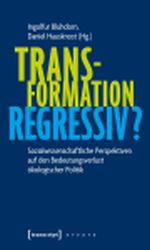
The IGN is celebrating its 10th anniversary this year.
In September, the institute will host its 5th international research conference. As part of this conference, we will be presenting our latest book at a public evening event on 24 September. The book features contributions not only from current and former IGN staff but also from many renowned social scientists from across the German-speaking world (and beyond).
We warmly invite all members of the Department of Socioeconomics, as well as all colleagues at WU, to this event and look forward to raising a glass with you afterwards to celebrate the IGN’s anniversary.
A new addition to the IGN team

In mid-July 2026, Julian Niederhauser joined the team at the Institute for Social Change and Sustainability (IGN) as a postdoctoral researcher. His research focuses on socio-ecological transformation and authoritarianism from a social science perspective.
In his doctoral thesis, recently submitted to Goethe University Frankfurt am Main under the supervision of Prof. Dr. Dennis Eversberg, he examines anti-transformative attitudes in the context of the climate crisis. Prior to joining the IGN, Julian Niederhauser was a doctoral fellow and, subsequently, coordinator of the Rosa Luxemburg Foundation's Research Training Group "Crisis and Socio-Ecological Transformation". He has also taught as a lecturer at the Institute of Political Science at the University of Vienna and at the BFI Vienna University of Applied Sciences. He is co-editor and contributing author of the edited volume “Struggles for Transformation: Critical Analyses and Interventions on the Socio-Ecological Crisis”, and has recently published the book chapter “The Potential Fossil Fascist: Traits of a Climate-Rebellious Attitude Syndrome”. His current research explores subject-related dimensions of societal militarisation.
We warmly welcome Julian to the IGN and look forward to our future collaboration!
Collapse and Solidarity-Based Prepping: Research Visit to Saxony
As part of the research project “Collapse Movements as a Post-Liberal Response to the Eco-Political Crisis: An Empirical Study of Solidarity-Based Prepping in Austria and Germany”, funded by the WU Small Projects programme, MA Lena Alwang conducted field research in Saxony from 6 to 12 July 2026. In collaboration with M.Sc. Hannah Pfister (European University of Flensburg), she interviewed individuals who are active in the so-called ‘collapse movement’ and who are preparing themselves, both emotionally and practically, for societal upheavals and breakdowns. The project aims to investigate how the relationship of (former) climate activists to science and the state, as well as their political energy and forms of solidarity, are shifting in the face of the failure of liberal climate governing.
The data collected during the residency will form part of a broader empirical study of solidarity-based prepping in Austria and Germany. Initial findings will be presented in the autumn at the international research conference ‘Ecological Ungovernability? Civic Empowerment – State Overload – Ungoverning’, which the IGN is organising from 23 to 25 September 2026.
Announcement of a New Partnership
The IGN is pleased to announce a new collaborative partnership as part of the project “Realigning Sustainability Policy in the Context of Multiple Crises.” Professor Blühdorn has been a collaborative partner since April 2026. For more information, click here.
1/2/2022
Michael Deflorian left the Institute for Social Change and Sustainability with February 1, 2022 and started at his new job.
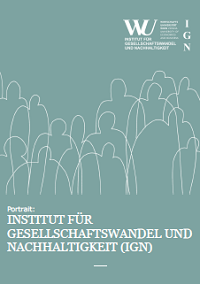
NEU: Institutsportrait
Das IGN hat ein aktuelles Institutsportrait herausgegeben, das einen Überblick über das wissenschaftliche Selbstverständnis des IGN, dessen Mitarbeiter*innen, sowie die Forschungsprojekte und Publikationen der letzten sechs Jahr beinhaltet.
Eine PDF-Version des Institutsportrait kann über diesen Link heruntergeladen werden.
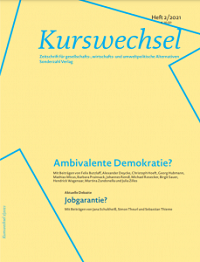
NEW PUBLICATION
Issue: "Kurswechsel 2/2021 – Ambivalente Demokratie" Herausgeber: Felix Butzlaff
Haben Parlamente und Partizipation in Zeiten von Populismus und Pandemie ausgedient? In welchem Verhältnis stehen Demokratisierungsforderungen und autoritäre Tendenzen? Wie hat das Krisenjahr 2020 unsere Vorstellungen von Demokratie verschoben? Diese Frage werden im Kurswechsel 2/2021 thematisiert und kritisch analysiert.
The table of contents and the Editorial can be found online.
30/4/2021
The IGN is pleased to welcome Dominik Schmerda, who will help with various tasks and activities as a student assistant from May onwards.
08/03/2021
Call for Papers
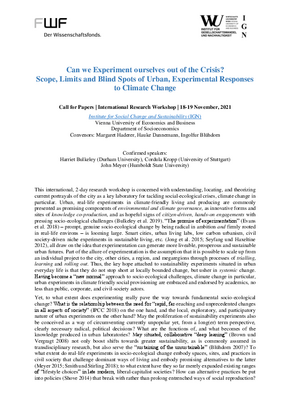
The IGN is glad to adverise and to circulate this Call for Papers for an international, two-day research workshop on the topic of Can we Experiment ourselves out of the Crisis? Scope, Limits and Blind Spots of Urban, Experimental Responses to Climate Change, which will take place on November 18-19, 2021. As the title suggests, the workshop is concerned with understanding, locating, and theorizing current portrayals of the city as a key laboratory for tackling social-ecological crises – climate change in particular. Some distinguished speakers like Harriet Bulkeley, Cordula Kropp and John Meyer have already confirmed their participation. Here you can find the detailed program.
The deadline for abstracts is April 15, 2021. If you have any questions, please contact Margaret Haderer(margaret.haderer@wu.ac.at) or Hauke Dannemann (hauke.dannemann@wu.ac.at).
Should you find this event to be of interest for other colleagues, feel free to share it.
02/07/2020
2nd EDITION
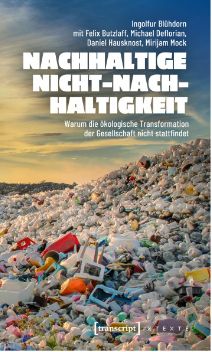
Ingolfur Blühdorn / Felix Butzlaff / Michael Deflorian / Daniel Hausknost / Mirijam Mock
Nachhaltige Nicht-Nachhaltigkeit. Warum die ökologische Transformation der Gesellschaft nicht stattfindet. Transcript Verlag, 2020.
Auch wenn Umweltbewegungen »Weiter so ist keine Option! Wende oder Ende!«fordern und der Begriff der Nachhaltigkeit voll im Mainstream angekommen ist – diemoderne Gesellschaft verteidigt ihren Wohlstand und Lebensstil entschiedener denn je. Beharrlich wird eine Politik der Nicht-Nachhaltigkeit betrieben, und die Konjunktur des Rechtspopulismus signalisiert zudem eine deutliche Abkehr vom ökologisch-demokratischen Projekt vergangener Jahrzehnte. Dieser Band stellt grundlegende Annahmen der Nachhaltigkeitsdebatte in Frageund skizziert neue sozialwissenschaftliche Forschungsperspektiven, um die eigenartige Fortdauer der Nicht-Nachhaltigkeit zu erhellen.
Hier finden Sie den Link zur neuen Leseprobe.
19/02/2020
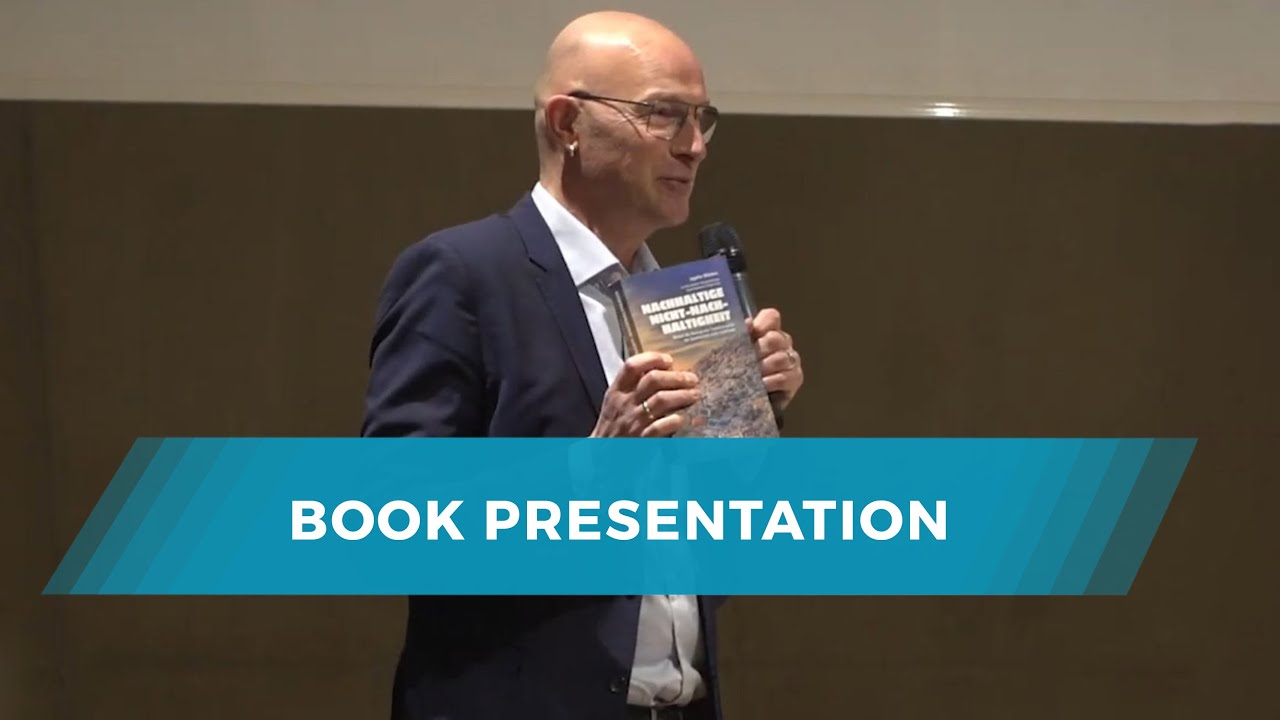
"Nachhaltige Nicht- Nachhaltigkeit"
The Institute for Social Change and Sustainability at the Vienna University of Economics and Business is discussing its new publication with international experts on the social blockades for a socio-ecological transformation to sustainability.
Nachhaltige Nicht-Nachhaltigkeit
Nachhaltige Nicht-Nachhaltigkeit
IGN Best Dissertation Award 2019
Laura Spitz ist Preisträgerin des IGN Best Dissertation Award 2019
Das Institut für Gesellschaftswandel und Nachhaltigkeit freut sich, den IGN Best Dissertation Award für das Jahr 2019 an Laura Spitz, B.Sc. zu verleihen.
Der IGN Best Dissertation Award wird bei einer öffentlichen Abendveranstaltung im März überreicht. Der Preis ist mit einem Büchergutschein verbunden. Zudem wird die Arbeit des oder der Preistragenden auf der Website des IGN veröffentlicht. Die Bachelorarbeit von Laura Spitz kann hier heruntergeladen werden.
NEW PUBLICATION
Ingolfur Blühdorn / Felix Butzlaff / Michael Deflorian / Daniel Hausknost / Mirijam Mock
Nachhaltige Nicht-Nachhaltigkeit. Warum die ökologische Transformation der Gesellschaft nicht stattfindet. Transcript Verlag, 2020.
Auch wenn Umweltbewegungen »Weiter so ist keine Option! Wende oder Ende!«fordern und der Begriff der Nachhaltigkeit voll im Mainstream angekommen ist – diemoderne Gesellschaft verteidigt ihren Wohlstand und Lebensstil entschiedener denn je. Beharrlich wird eine Politik der Nicht-Nachhaltigkeit betrieben, und die Konjunktur des Rechtspopulismus signalisiert zudem eine deutliche Abkehr vom ökologisch-demokratischen Projekt vergangener Jahrzehnte. Dieser Band stellt grundlegende Annahmen der Nachhaltigkeitsdebatte in Frageund skizziert neue sozialwissenschaftliche Forschungsperspektiven, um die eigenartige Fortdauer der Nicht-Nachhaltigkeit zu erhellen.
Please find here the video
NEW PUBLICATION
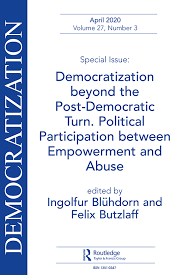
In the issue, we explore changing understandings of participation in contemporary Western representative democracies through the analytical lens of the concept of the post-democratic-turn. We investigate technology-based, market-based, and expert-led innovations that claim to enhance democratic participation and to provide policy legitimation. We review these changing understandings of participation in light of their contribution to further democratization. The issue addresses how under post-democratic conditions the simulative performance of autonomy and subjectivity has become central to democratic participation. It emphasizes that what in established perspectives on democratization might appear as an abuse of participation, through the lens of a post-democratic-turn might be perceived as emancipatory and liberating.
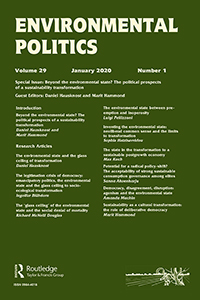
NEW PUBLICATION
About half a century ago, modern democratic states started to respond to environmental pressures that had arisen in the wake of rapid industrialization. Initially, governments set up environmental ministries and agencies and issued legislation to control the pollution of air and water and to manage industrial processes, waste and toxic substances. Later, states expanded their activities to intervene more deeply into the energy and resource flows of their countries, for example by setting up recycling schemes, promoting and subsidizing environmentally efficient technologies and investing in the environmental education of their citizens. Typically, they also released budgets for environmental research activities and created more nature reserves and national parks. More recently still, states began to horizontally integrate environmental concerns into other policy areas, to set up mechanisms for public participation in selected environmental policy decisions and to commit to national goals for the reduction of greenhouse gas emissions. Overall, states have developed a host of coordinated activities to manage and steer societal-environmental interactions on various scales.