
Impact-based management
Authors: Christian Grünhaus & Stefan Schöggl (2025)
The activities and services provided in the social sector are not an end in themselves. Rather, the common goal of all stakeholders is to improve society, make it more livable, enhance resilience, create space for inclusion, and initiate change—in short, to generate societal impact. However, the current measurement and reporting typically focus only on the volume of services rendered in the form of performance indicators, such as the number of service hours provided to a certain number of individuals. The extent to which the desired impacts have actually been achieved often remains uncertain, at least at the organizational and inter-organizational levels.
Not only is reporting currently based on performance indicators and efficiency, but management also follows this approach. Impacts are often overlooked, assumed, and only sporadically measured in evaluations. However, knowledge about the impacts of the services provided is often available or relatively easy to ascertain—specifically where staff work directly with the affected individuals, that is, at the grassroots level, right at the point of service delivery.
There is a growing awareness that performance indicators and financial audits provide little insight into the societal impacts of activities in the social sector. A desirable goal is to establish a system that allows for effective communication about the results of valuable work in the social economy and enables learning, informed management, and strategic decision-making based on this information.
Why is the path from measuring and managing success through services to impacts rarely taken? Transitioning to a new system is challenging. However, there are already numerous building blocks for such an integrated system, as well as a conceptual foundation. To manage based on impact, sufficient information about the effects of the services would be necessary. Below, we will first present the conceptual foundation, the impact-based management box, second, describe how it can be applied in an inter-organizational manner, and third, outline the steps needed for implementation.
The impact-based management box is founded on the logic that every service produces an output, which in turn leads to intended and unintended impacts. Management, as a conscious process, focuses on the intended impacts. These are anchored in impact goals and arise among a range of stakeholders and impact-affected individuals. In Figure 1, this is illustrated by the layer extending backward into the red area.
Stakeholders have an interest in and influence over the organization and its services. In contrast, impact-affected individuals do not have a particular interest in the organization and its provided services, nor do they exert influence over them, yet they are significantly affected by the impacts of these activities.
This distinction is crucial for understanding how to effectively manage and evaluate the societal impacts of services in the social sector. By recognizing the different roles of stakeholders and impact-affected individuals, organizations can better align their strategies to achieve meaningful outcomes and enhance their contributions to societal well-being.
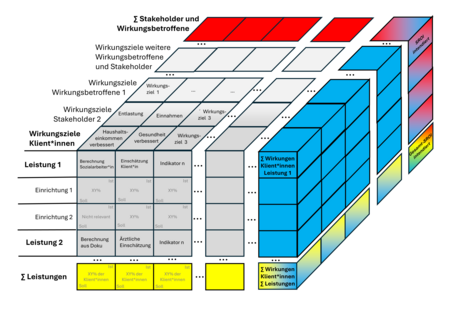
Not every service produces every intended impact. However, multiple services typically address specific impact goals and contribute to their achievement with varying degrees of intensity. At the level of a specialized field or the overall organization, the aggregation of impacts across services (yellow area in Figure 1) and often also across stakeholders or affected individuals (red area in Figure 1) is of interest.
The concept of the management box allows for the aggregation based on the number and proportion of affected stakeholders or individuals for whom the respective impact occurs. This can also be done according to levels of intensity, if applicable. This flexibility enables the use of different indicators depending on the service, allowing for a tailored data collection design for various services. Thus, impact statements can be made both for individual services and across services. As shown in Figure 1, improved health, for example, could be measured through subjective assessments by clients or through medical evaluations. The proportion of individuals with improved health, weighted by the number of affected persons, is then included in the aggregation. Simultaneously, both for the individual service and in aggregate, a target value is established and checked against the actual values to see if they align. This provides guidance for individual facilities, services, and the overall organization.
Sometimes, there is also a desire to aggregate the diverse impacts themselves to represent the total societal value of a service. This is indicated by the blue area on the right in Figure 1. A prerequisite for this is the aggregation of different impacts. One possibility for achieving this is the monetization of impacts, as is done in a Social Return on Investment (SROI) analysis (Grünhaus, 2023). This allows for statements about how much societal value, expressed in monetary units, the sum of the intended impacts of a service represents for a stakeholder.
The management box is not conceptually limited to use within a small organization, a complex large organization, or across organizational boundaries. In addition to the approach outlined above within an organization, inter-organizational use is also conceivable. The following will address the implementation within such an inter-organizational structure, where various relevant actors in the social sector are involved in a co-creation process.
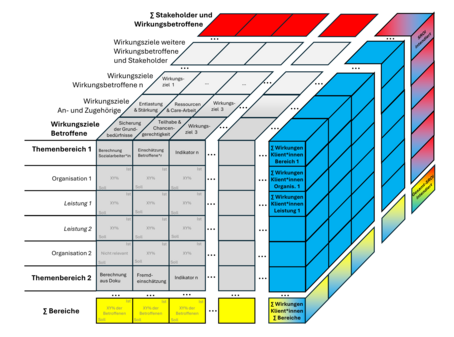
In the social sector, there are services designed to generate intended impacts for defined vulnerable groups and other affected individuals. Most of these services are provided by nonprofit organizations in the social sector (social NPOs) on behalf of the state and municipalities. This can be represented in the form of an inter-organizational management box, as shown in Figure 2.
While the internal management box (Figure 1) captures only the service and the organization, the inter-organizational management box encompasses thematic areas (e.g., care, child and youth welfare), organizations (e.g., Caritas, Vorarlberger Kinderdorf), and services (e.g., mobile care, group homes). Furthermore, it would be entirely feasible to incorporate a fourth level, namely the different facilities providing services within each organization (e.g., individual social counseling centers or care facilities).
The advantage of such an inter-organizational solution is that it fosters a shared understanding and a common set of indicators, rather than relying on numerous organization-specific, incompatible isolated solutions. This approach not only enhances collaboration among organizations but also improves the overall effectiveness of service delivery by aligning goals and measurement criteria across the sector.
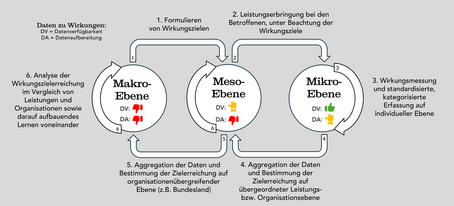
To enable inter-organizational learning and management, a system-wide understanding of impact goals, data availability, and aggregation possibilities is needed, in addition to the conceptual foundation. As shown in Figure 3, data availability at the micro level in the social sector is predominantly good. Here, ongoing impact analyses are most frequently conducted in terms of reflecting on individual cases. However, at the meso and especially macro levels, both the availability of data on impacts and the analysis towards impacts are significantly poorer. To improve the data situation regarding impacts, several steps must be taken, which are also illustrated in Figure 3.
At the inter-organizational level, the first step is to collaboratively develop impact goals that apply equally to all organizations. At the macro level, this can often build on socially desired impact goals and existing target formulations, as already outlined in legal frameworks. For example, §3 Abs. 2 of the Vorarlberg Child and Youth Welfare Act states: "Child and youth welfare encourages and supports children and young people and their caregivers to strengthen, expand, and utilize their own abilities and skills." Article 27, Paragraph 1, Point 10 of the UN Convention on the Rights of Persons with Disabilities (UN-CRPD) formulates the goal of "promoting the acquisition of work experience in the general labor market by persons with disabilities." Concrete target values for these goals must be jointly established through negotiations among all involved stakeholders to achieve a high level of understanding regarding the significance and importance of the initiative.
The activities and services of the organizations will then be aligned with the formulated impact goals. Additionally, the impact goals defined at the macro level must be further specified at the organizational and service levels.
A logical developmental step towards impact-based management would be to achieve higher data availability at the meso level. At the micro level, data on individual affected persons should be collected more in line with the formulated impact goals and categorized accordingly. This way, they would subsequently be easier to categorize at the meso level of the organization and available for further processing. This improved data situation at the organizational level would, on one hand, enable impact-based management of the organization and its services (meso) and, on the other hand, form the basis for steps that extend beyond the respective organization. Thus, the system can be utilized for overall management at the inter-organizational level, provided that there is prior agreement on overarching impact goals, as well as possible indicators and success thresholds.
Process for Concrete Implementation
To enable such an approach, the involved stakeholders must reach agreements through several steps. First, specific impact goals must be established and articulated in sufficient detail for effective impact measurement. Second, it needs to be clarified which services will be considered. If necessary, the impact goals may need to be refined for the selected services. Third, impact measurement must take place, and appropriate indicators and data collection designs must be selected for this purpose. Fourth, aggregation at the meso level must be implemented, and fifth, if applicable, at the macro level. Finally, there must be clarity regarding data analysis, reporting, and learning settings to effectively utilize impact analysis.
Step 1: Formulating Impact Goals
To manage based on impact, it is essential to first clarify which impacts are to be achieved. This involves defining impact goals, which refer to the intended positive changes that an organization or a service brings about for a specific stakeholder. Since the primary impacts may differ between services or specialized areas, it is crucial to involve a diverse group of stakeholders who have the relevant content knowledge.
Impact goals must be formulated in a way that is general enough to encompass the diversity of organizations and their services while also being clear and precise enough to ensure a unified understanding of the impact goal across service and organizational boundaries.
Even well-formulated impact goals in the initial step are not necessarily final. It is advisable to remain open and to iteratively adapt impact goals as their formulation is tested against subsequent steps. For instance, when adapting impact goals to specific services and developing indicators, it may become apparent that several impact goals cannot be distinctly separated from one another.
This iterative process allows organizations to refine their impact goals continuously, ensuring they remain relevant and effective in guiding their activities and measuring their societal impacts.
Step 2: Service Delivery to Affected Individuals, Considering Impact Goals
In aller Regel wird ein System der wirkungsbasierten Steuerung in eine bereits bestehende Leistungserbringung eingebettet. Es werden also Leistungen (z.B. mobile Pflege, Arbeitsmarktintegration) erbracht, mit entsprechenden Prozessen zur Umsetzung, Dokumentation, Berichtslegung und Abrechnung. Hier gilt es zunächst zu klären, welche Leistungen oder Leistungsbündel in ein System der wirkungsbasierten Steuerung aufgenommen werden. Es werden nicht alle Leistungen sein, wenn beispielsweise Leistungen in absehbarer Zeit auslaufen, Sonderleistungen für sehr spezifische Fälle bestehen oder die wirkungsbasierte Steuerung nur für einen Teil der Leistungen eingeführt werden soll.
Weiters müssen dann die in Schritt 1 erarbeiteten, übergeordneten Wirkungsziele auf die Leistungen angepasst werden. So muss beispielsweise konkretisiert werden, was „Verhinderung sozialer Isolation“ in einer konkreten Leistung bedeutet. Dies wird in einem stationären Pflegesetting anders aussehen als in einer Wohnbetreuungsmaßnahme. Allenfalls können hier auch bereits Soll-Werte im Sinne des gewünschten Ausmaßes der Zielerreichung festgelegt werden. Gilt es also soziale Isolation für alle betreuten Personen zu vermeiden oder nur für einen Anteil? Gegebenenfalls ist ein Wirkungsziel für eine konkrete Leistung nicht relevant. Das sollte dann entsprechend entschieden werden. Erfahrungsgemäß kommt es auch umgekehrt vor, dass manche Leistungen spezifischere Wirkungen intendieren, zu denen dann auch noch das eine oder andere Wirkungsziel formuliert wird. Diese Wirkungsziele dienen dann der wirkungsbasierten Steuerung auf Leistungsebene und fließen nicht in die Aggregation auf Makrobene ein.
In der Umsetzung empfiehlt sich hier in einem ersten Schritt, seitens der relevanten Systemakteur*innen auf (Fach)Bereichsebene gemeinsam zu klären, welche Leistungen zentral auf die erarbeiteten Wirkungen einzahlen und dies dann für die wirkungsbasierte Steuerung auszuwählen. Allenfalls werden Leistungsbündel definiert, wenn manche Leistungen häufig, oder bei bestimmten Zielgruppen, in Kombination in Anspruch genommen werden.
In einem zweiten Schritt sollten dann Personen, die mit der konkreten Leistungserstellung vertraut sind, prüfen, welche übergeordneten Wirkungsziele durch die Leistungserbringung erreicht werden können. Diese Wirkungsziele gilt es dann durchzugehen und gegebenenfalls Konkretisierungen in der Formulierung vorzunehmen. So könnte die Verhinderung der Isolation in einer Pflegeeinrichtung beispielsweise bedeuten, dass die Bewohner*innen so und so oft an Gruppenaktivitäten teilnehmen oder so und so oft besucht werden. Bei diesem Schritt findet zumeist ein fließender Übergang in Richtung Indikatorenbildung und konkreterer Schritte der Wirkungsmessung statt.
Step 3: Impact Measurement and Standardized, Categorized Data Collection at the Individual Level
Once specific impact goals have been defined and adapted to the selected services, the first step toward measurement follows. It is essential to clarify how information can be obtained regarding the changes experienced by the affected stakeholders as a result of the services provided. A key aspect is understanding whether, when, and how data collection is meaningful. Most organizations already collect a variety of data, such as assessments, ongoing documentation, or reports. In many cases, these contain valuable insights into whether certain impacts are occurring. Therefore, it is advisable to carefully examine existing data sources, as they can often be directly translated into impact indicators.
If existing data is not directly suitable for impact measurement, it is often beneficial to make slight adjustments to the documentation systems. Small adaptations toward standardization can prove crucial in terms of efficiency. For example, the health status of a client can be captured using a standardized Likert scale. This allows for comparisons over time and measurement of health impacts, enabling statistical analysis while simultaneously reducing documentation effort. Once existing sources have been maximized, the possibilities for new data collection should be explored. In this case, it is advisable to think resource-efficiently, integrating additional data collection into existing processes whenever possible.
After exploring data collection options, the development of impact indicators should follow, which will provide information about the achieved impacts. These indicators should be able to be integrated into ongoing work with minimal additional effort. Quantitative impact indicators capture the impact using a standardized measurement instrument across a large number of individuals, providing insights into how many people experienced the impact and to what extent. In other words, they measure the breadth and intensity of the impact. This differs from qualitative methods of impact analysis, where qualitative surveys involve in-depth interviews with a selected group of observed stakeholders to explore complex impact relationships.
A central challenge is to find a balance between scientific rigor and applicability. In scientific studies, the effectiveness of measures is typically measured using scientifically validated questionnaires and a control group. This increases accuracy and minimizes confounding factors. Such a rigid approach is often unnecessary for organizations to capture their impacts and can be difficult to implement in the daily work of staff. Therefore, impact measurement should be limited to as few and quickly answerable questions as possible, with the analysis being as straightforward as possible.
In practice, it is recommended that those familiar with the specific service delivery and involved in the impact goal adaptation process collaborate with social science-trained individuals to prepare the specific data collection instruments. It is essential to ensure that the collected data and information are ultimately categorized according to impact goal achievement levels (e.g., fully achieved, partially achieved, or not achieved) and entered into an IT system that allows for subsequent data aggregation.
A larger inter-organizational process offers several synergies. For instance, impact measurement in different care facilities or counseling centers is likely to proceed in the same or very similar manner. Accordingly, in a regional implementation, one organization could develop indicators and data collection methods for employment inclusion services, while another could focus on housing issues. The results could then be exchanged and slightly adapted as needed. Organizations can also learn from each other regarding IT processes and mutually adopt best practice processes.
Steps 4 & 5: Data Aggregation and Determination of Goal Achievement at the Higher Service or Organizational Level, as well as at the Inter-Organizational Level (e.g., State Level)
Once the impact information has been collected at the micro level, the first step of aggregation toward the meso level of the organization must be taken. Here, the focus is on the extent to which the impact goals have been achieved within a specific timeframe. At the end of the observation period, for example, at the end of the year, data is collected on how many individuals who utilized a service, such as mobile care or a bundle of labor market integration measures, experienced the intended impact. For instance, how many individuals are socially less isolated than before they accessed the service? The intensity of the reduction in isolation can also be considered (e.g., significantly less isolated). This information contributes to the percentage of impact goal achievement for a service at the level of the social non-profit organization (NPO) within the framework of the impact-based management concept and simultaneously contributes to cross-service impact goal achievement. Thus, the social NPO can make statements about a) the extent to which a specific impact goal was achieved through a particular service and b) the extent to which it, as an organization, was able to achieve specific impact goals. The aggregation is based on the percentage of each stakeholder who experienced the impact, regardless of the service and indicator.
In a second step, the achievement of impact goals can also be presented at the inter-organizational level. For this purpose, performance and, if applicable, organizational data must be aggregated at the macro level. Specifically, information on impact goal achievement needs to be consolidated through an IT interface to enable aggregated evaluation. For this reason, it is advisable to involve IT representatives in the process. As a result, if all organizations of a particular service type are connected, impact statements can be made for the entire region. At this point, the impact goals are substantiated with concrete actual data, allowing for the calculation of the percentage of individuals served or other stakeholder groups who experienced a specific impact. A statement such as, "We have reduced social isolation for 85% of the individuals served in the area of care," becomes possible.
A certain challenge in developing indicators is the heterogeneity of organizations and services, which must be taken into account during aggregation. It cannot be assumed that the same indicator can be used to measure an impact goal across all services of all organizations in every conceivable setting. To address this aspect, multiple indicators should be established depending on the various specialized areas, organizations, and facilities that measure the same impact goal. The aim is to develop a set of indicators for each impact goal from which the appropriate one can be chosen based on the setting. This ensures comparability while allowing for setting-specific adjustments. If necessary, this set of indicators can be expanded. The indicators must be developed in close coordination to ensure the validity of the system.
In implementation, it is advisable to achieve a high degree of automation in the evaluation, both within an organization and across organizations. Clarity about the exact processes must be established. It should be clear who is responsible for data retrieval and data consolidation at both the organizational and regional levels; in other words, a clear distribution of roles is needed. Additionally, the timing of data collection and reporting periods must be clearly defined.
Step 6: Analysis of Impact Goal Achievement in Comparison of Services and Organizations, and Subsequent Learning from Each Other
Liegen Ist-Werte vor, können diese mit vorab festgelegten Soll-Werten verglichen werden. Solcherart lässt sich je Wirkungsziel eine Abweichungsanalyse durchführen: Inwiefern wurde der Soll-Wert erreicht? Wurde er über- oder unterschritten? Wie kam es dazu? Die Ergebnisse einer solchen Abweichungsanalyse sind die Basis für organisationales und sektorales Lernen und Steuern.
Organisationsintern kann eine Sozial-NPO bei entsprechender Größe und Heterogenität der Zielgruppen Vergleiche zwischen Leistungen und Gruppen anstellen. Solcherart können Lerneffekte zu Wirkungen der erbrachten Leistungen auf Organisationsebene angestoßen werden. Noch interessanter wird es, wenn Vergleiche zur Wirkungszielerreichung auf Makroebene zwischen Leistungen und ggf. leistungserbringenden Organisationen gemacht werden. Solcherart könnten Leistungen identifiziert werden, die wirkungsvoller sind. Hier kann dann im Sinne des Lernens genauer hingesehen werden, was den Erfolg ausmacht und inwiefern dies a) in andere Leistungen implementiert werden kann oder b) von anderen Organisationen übernommen werden kann. Systemübergreifendes Lernen wird initiiert.
In der konkreten Umsetzung dieses abschließenden Schritts sind die Rahmenbedingungen dahingehend zu gestalten, dass einerseits ein Gefühl der Kontrolle vermieden wird und andererseits eine destruktive Konkurrenz zwischen den Sozial-NPOs oder innerhalb einer Organisation zwischen unterschiedlichen Leistungserbringern verhindert wird. Das Ziel wirkungsbasierter Steuerung besteht vielmehr in der Förderung konstruktiver Lernprozesse und der Generierung innovativer Lösungen, die zum Wohle der Stakeholder, im Sinne einer besseren, breiteren Wirkungszielerreichung beitragen. Im Mittelpunkt sollte stets die Generierung von gesellschaftlichem Mehrwert stehen, was schließlich das primäre Anliegen aller Beteiligten und der Wirkungsziele ist.
Um dieses Potenzial voll auszuschöpfen, empfiehlt sich in der operativen Umsetzung des Lernprozesses, institutionalisierte Formate zu etablieren, die über reine Berichte hinausgehen. Es gilt, explizit Räume für den Austausch zu schaffen – etwa durch regelmäßige Reflexionsworkshops oder Qualitätszirkel. Besonders für das systemübergreifende Lernen bieten sich praxisnahe Methoden an: Feldbesuche bei anderen Organisationen oder Formate der Peer-Beratung ermöglichen es, theoretische Erkenntnisse vor Ort zu validieren und Good-Practices direkt im Anwendungskontext zu erleben.
Conclusion
The outlined approach to establishing impact-based management within an entire social system is new and innovative. Its implementation facilitates a reconciliation between socially desired impact goals and the information used for management. This stands in contrast to the current management practices based on performance information, which overlook impacts and neither address nor measure them.
The goal of impact-based management is to capture the scope and intensity of impacts among larger groups of clients, derive correlations with the services provided, and achieve optimization of those services based on this data. This makes it possible to identify which services prove to be more effective. The analysis of causal relationships related to specific sub-services is excluded, meaning the question of which aspects of a service are effective and why is not the focus. Instead, the emphasis is on the service as an aggregate. The presence of a greater number of impact indicators within the system facilitates access to the experiences of other projects or organizations. In addition to management, this also allows for the evidence-based visibility of the results of one’s own work. The representation of the impacts achieved in their breadth significantly contributes to the credibility and professionalism of the sector.
References
Grünhaus, C. (2023). Wirkungsindikatoren und SROI: organisationale Steuerung und Legitimation anhand des gesellschaftlichen Mehrwerts. In Indikatoren in Entscheidungsprozessen: Stärken und strukturelle Schwächen (pp. 73-85). Wiesbaden: Springer Fachmedien Wiesbaden.
Grünhaus, C. & Rauscher, O. (2021). Impact und Wirkungsanalyse in Nonprofit Organisationen, Unter-nehmen und Organisationen mit gesellschaftlichem Mehrwert: Vom Wirkungsmodell über die Messung, Bewertung bis zur Steuerung, Darstellung und Kommunikation. https://research.wu.ac.at/ws/files/19857361/Gr%C3%BCnhaus_Rauscher_Impact_Wirkungsanalyse_gesellMehrwert_Apr2021.pdf
Grünhaus, C. & Rauscher, O. (2022). Evaluation und Wirkungsmessung. in M. Meyer, R. Simsa, & C. Badelt (Hrsg.), Handbuch der Nonprofit-Organisation: Strukturen und Management (6. Aufl., S. 507-528). Schäffer Poeschel.
Grünhaus, C. & Schöggl, S. (2024). Der gesellschaftliche Mehrwert der Sozialwirtschaft Vorarlberg: Endbericht. https://doi.org/10.57938/71dc1944-a66f-4405-919b-6330f3592dbd
Grünhaus, C. & Schöggl, S. (2025). Wirkungsbasierte Steuerung. https://www.wu.ac.at/npocompetence/wir-fuer-sie/begleitung-und-beratung/wirkungsbasierte-steuerung
Grünhaus, C., Kettl, J., Pascher, L. & Schuster, K. (2025). Wirkungsbasierte Steuerung bei der Caritas Wien - Hilfe in Not. VM Fachzeitschrift für Verbands- und Nonprofit-Management 3/25.
Kinder- und Jugendgesetz in Vorarlberg (KJHG) (2025). https://www.ris.bka.gv.at/GeltendeFassung.wxe?Abfrage=LrVbg&Gesetzesnummer=20000417&FassungVom=2021-03-31
UN-Behindertenrechtskonvention (UN-BRK) (2008). BGBl. III Nr. 155/2008. https://www.ris.bka.gv.at/eli/bgbl/III/2008/155/20081023