Social effects
"Value is created when a specific activity by individuals, groups, or organizations contributes additional benefits toward fulfilling (fundamental) societal goals."
An impact can fundamentally be any conceivable change in a situation. Essentially, every action produces impacts, and even inaction can have effects, as Schober/Rauscher (2014) demonstrate. But when does it constitute a societal (core) impact? This occurs when the change targets particularly relevant societal goals. These are often codified as fundamental societal values and listed in respective constitutions or catalogs of fundamental rights. Societal values and goals can also be understood as an aggregate of individual human needs. For instance, every person has a certain individual need for security, which can be reflected at the societal level in fundamental values such as the "right to life."
Societal fundamental values (e.g., freedom or tolerance) and individual needs can serve as the basis for a demand that can be met by the services of organizations, businesses, or institutions. Services include not only products and services but also activities such as advocacy that can lead to societal impacts.
Technically, societal goals can be achieved through two different pathways. First, by inducing changes directly at the structural macro level, influencing institutions, values, and norms. Second, by effecting changes at the individual level, which, due to their extensive significance for many individuals, can lead to socially meaningful changes.
As an example of societal impacts at the individual level, consider the voluntary establishment of barrier-free living and working spaces. There is an individual need for accessible spaces, and this need is met by the available offerings. In this way, affected individuals with disabilities can better integrate into society, contributing to the fundamental value of equality. In contrast, the second example, the UN Convention on the Rights of Persons with Disabilities, operates at the societal macro level. Here, advocacy has led to changes in legal norms. For example, it is mandated that individuals with disabilities must be enabled to live independently and fully participate in all areas of life (Article 9, Paragraph 1). Consequently, barrier-free living and working spaces must also be established. Thus, the abstract norm influences society from the macro level and leads to changes at both the organizational and individual levels.
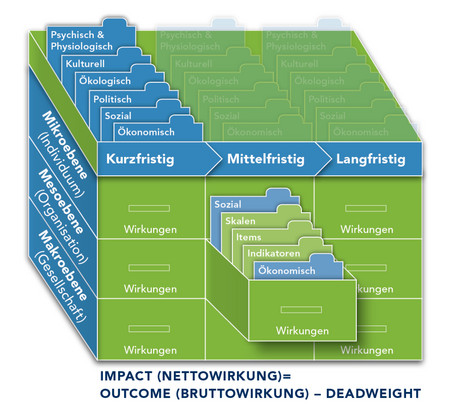
This example illustrates that societal impacts can occur at structurally different levels (micro, meso, and macro) and can also take on different dimensions. They can have cultural, political, social, economic, ecological, psychological, and physiological dimensions. Temporally, services can produce immediate short-term impacts, as well as medium- and long-term effects following their implementation. The Impact Box (see illustration below) serves as a strategic and analytical tool to build a more complex impact model and to represent and communicate it in a more differentiated manner.