
The Experience of Ownership
When people experience ownership, they feel that something is at least somewhat “mine”. Humans are capable of experiencing ownership for a product, idea, brand or even the planet and this experience shapes our behavior. At m.core@wu we are proud to be a recognized international hub of this research domain. Watch this video or our video playlist "The Science of Ownership" to see for yourself what makes this topic so very fascinating, follow our blog, check out the events we are organizing or browse through WUs unique collection on Possession, Ownership and Property (POP).
Main contact person in this research area:

Bernadette Kamleitner
Does packaging transparency make you more likely to buy a product?
Transparent packaging allows consumers to view and inspect the product. We suggest that transparent packaging reduces the psychological barrier between a product and its prospective consumers, and we propose that transparency allows for a more intimate bond with the product and thus increases product preference compared to opaque packaging. In seven studies, we find that consumers prefer products that can be seen through transparent packaging and that psychological ownership plays an important role in this. Drawing on this theory, we also provide evidence for relevant boundary conditions: The preference for products in transparent packaging is reduced when the unpackaged product would be undesirable, and when ownership is not expected (i.e., when the product is bought for someone else). These results extend prior accounts based on packaging attractiveness and product information, they advance the literature on psychological ownership, and they provide valuable insights for practitioners.
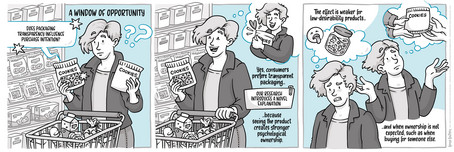
Marckhgott, E., Kamleitner, B., & Estes, Z. (2026). A window of opportunity: transparent packaging affects product preference via psychological ownership. International Journal of Research in Marketing. https://doi.org/10.1016/j.ijresmar.2026.01.008
Can our imagination breed ownership?
Humans have the marvellous capacity to imagine and simulate what could be. In this research we show how this capacity can make consumers behave like owners of things they clearly do not (yet) own. We find that imagination can be so very persuasive because it is prone to happen from the perspective of an owner. In another project, we find that even the mere scent of an object can bring an object so close to us that we start feeling like it was ours already.
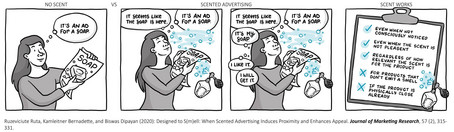
Ruzeviciute, R., Kamleitner, B., & Biswas, D. (2020). Designed to S(m)ell: When Scented Advertising Induces Proximity and Enhances Appeal. Journal of Marketing Research, 57(2), 315–331. https://doi.org/10.1177/0022243719888474
Kamleitner, B., & Feuchtl, S. (2015). As if it were mine: Imagery works by inducing psychological ownership. Journal of Marketing Theory and Practice, 23(2), 208 - 223. https://www.jstor.org/stable/48540563
Kamleitner, B. (2011). When imagery influences spending decisions: the role of ownership simulations. Journal of Psychology, 219(4), 231 - 237. https://doi.org/10.1027/2151-2604/a000077
What is the role of ownership experiences in addressing contemporary challenges?
Many things are currently at stake and under debate, that ranges from the environment to people’s data. We show why it is hard yet possible to feel ownership for such abstract things as the environment or data and why doing so may be an important angle in addressing the accompanying issues.
1 Paper 1 Minute - Bernadette…
Upon activation, some data may be transmitted to third parties (YouTube). For further information, please see our Data Protection Statement.
Kamleitner, B., & Mitchell, V. (2019). Your Data Is My Data: A Framework for Addressing Interdependent Privacy Infringements. Journal of Public Policy and Marketing JPP&M, 38(4), 433 - 450. https://doi.org/10.1177/0743915619858924
Kamleitner, B., & Mitchell, V-W. (2018). Can consumers experience ownership for their personal data? From issues of scope and invisibility to agents handling our digital blueprints. in Joann Peck & Suzanne B. Shu (Hrsg.), Psychological Ownership and Consumer Behavior (S. 91 - 118). Springer. https://doi.org/10.1007/978-3-319-77158-8_6
Süssenbach, S., & Kamleitner, B. (2018). Psychological ownership as a facilitator of sustainable behaviors. in Joann Peck & Suzanne B. Shu (Hrsg.), Psychological Ownership and Consumer Behavior (S. 227 - 238). Springer. https://doi.org/10.1007/978-3-319-77158-8_13
Kamleitner, B., Mitchell, V., Stephen, A., & Kolah, A. (2018). Your Customers May Be the Weakest Link in Your Data Privacy Defenses. MIT Sloan Management Review. https://doi.org/10.1177/0743915619858924
Is there a relationship between happiness and ownership?
The relationship between happiness and ownership is a complicated one because it depends on what we decide to own. Having said that the picture becomes much clearer when we look at “psychological” ownership, i.e. feeling that something is mine. We show that there is a positive link between happiness and the usage of products that one feels psychological ownership for. Momentary happiness leads to psychological appropriation, i.e. whenever I am happy, I am more likely to claim things as mine, and vice versa, i.e. I feel that the things I interact with are mine and that makes me happy. This is actually part of why consuming branded goods can make people feel better than consuming unbranded goods; in particular if brands promise to make us feel happy, chances are that we will feel more happy and more likely to claim them as our.
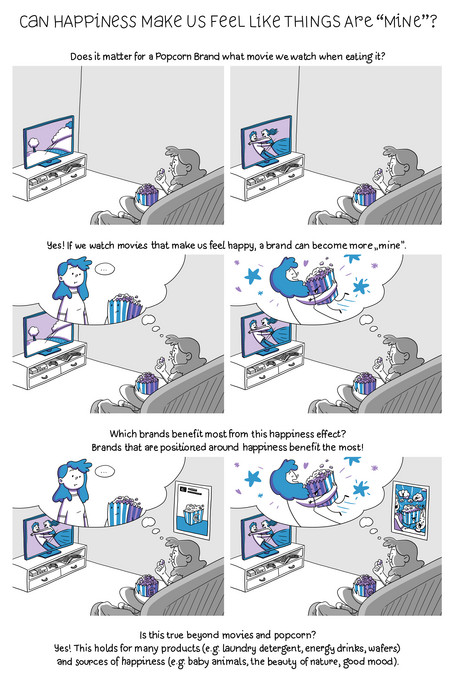
Thürridl, C., Kamleitner, B., Ruzeviciute, R., Süssenbach, S., & Dickert, S. (2020). From happy consumption to possessive bonds: When positive affect increases psychological ownership for brands. Journal of Business Research, 107, 89 - 103. https://doi.org/10.1016/j.jbusres.2019.10.019
Additional research questions
| Does the type of payment affect the degree to which things become mine? |
Kamleitner, B., & Erki, B. (2013). Payment method and perceptions of ownership. Marketing Letters, 24(1), 57 - 69. https://doi.org/10.1007/s11002-012-9203-4
.
| How does digitalization affect our ability to own things psychologically? |
Kamleitner, B., & Kokkoris, M. (2022). How Digitalization Blurs Boundaries, Makes Things Ungraspable, and Affects Psychological Appropriation. in R. Llamas, & R. Belk (Hrsg.), The Routledge Handbook of Digital Consumption Routledge, Taylor & Francis Group. https://doi.org/10.4324/9781003317524-4
Kamleitner, B. (2018). Blurring Boundaries and the Erosion of Ownership. in Luks, F. (Hrsg.), Chancen und Grenzen der Nachhaltigkeitstransformation (S. 109 - 130). Springer. https://doi.org/10.1007/978-3-658-22438-7_7
.
| Does it matter how we come across offers? |
Kokkoris, M. D., Hoelzl, E., & Kamleitner, B. (2020). "Self-found, spellbound: The sense of own discovery shapes customer bonds with service venues." Journal of Business Research 113: 303-316. https://doi.org/10.1016/j.jbusres.2019.09.045
Institute for Marketing & Consumer Research