![[Translate to English:] WU Bühne Festsaal](/fileadmin/wu/_processed_/3/6/csm_wumatters_square_9a9ff67bfe.jpg)
Summer semester 2025
Let’s Talk Money! How Can Austria Shake Off Its Debts?
Let’s Stand Up Against Online Hate!
How Austrians Invest their Money
Can We Bury Carbon Underground?
Let’s Talk Money! How Can Austria Shake Off Its Debts?
Austria’s budget deficit is forecast to rise to 4.1 percent in 2025, soaring well above the EU’s three percent Maastricht limit for annual government deficit relative to GDP. This means that Austria’s new government will inherit a massive debt burden, which will make it necessary to save billions of euros in 2025 alone. But how? How much can Austria really save through cuts in government spending? How much additional revenue can be raised from taxes and fees? And are pension reforms inevitable now? These questions will be the focus of our panel discussion with experts including former WU Rector Christoph Badelt, now president of the Austrian Fiscal Advisory Council.
Lecture
Christoph Badelt, President of the Austrian Fiscal Advisory Council; WU Vienna
Discussion
Christoph Badelt, President of the Austrian Fiscal Advisory Council; WU Vienna
Franz Schellhorn, Director of Agenda Austria
Margit Schratzenstaller, Senior Economist, WIFO
Helene Schuberth, Managing Director of the Austrian Trade Union Federation (ÖGB)
Moderated by
Karin Heitzmann, Head of the Research Institute for the Economics of Inequality, WU Vienna
Let’s Stand Up Against Online Hate!
Hate speech, online firestorms, cyberbullying ... violence through words is becoming more and more widespread online. Users provoke, insult, and threaten each other in a way that many of us find hard to bear. What forms does digital violence take? Where does it come from? What do hateful online comments do to us and our society? Do we have to accept that many people experience verbal violence online? What legal safeguards are in place to protect us? And how can we stop online bullying?
Lecture
Philipp Homar, Full Professor and Head of the Information and Communication Technology & Intellectual Property Law Group, WU Vienna
Marius Lüdicke, Full Professor of Marketing and Head of the Institute for International Marketing Management, WU Vienna
Discussion
Ingrid Brodnig, Award-winning journalist, writer, and columnist for the daily “Der Standard”, Expert on disinformation and hate speech on social media, Digital Ambassador of Austria to the EU
Meri Disoski, Member of the Austrian Parliament, Member of the Federal Board of the Greens, Spokeswoman for International and European Affairs and Equal Opportunities
Susanne Lackner, Deputy Chairperson of KommAustria, responsible for the tasks of the Austrian Digital Services Coordinator, KommAustria
Georg Kodek, Full Professor of Civil and Business Law, WU Vienna, President of the Austrian Supreme Court of Justice
Moderated by
Elfriede Penz, Associate Professor of Marketing, Deputy Chair of the Institute for International Marketing Management, WU Vienna
How Austrians Invest their Money
By international standards, Austria is a country where saving money is very important to people, but many are still reluctant to invest in stocks and other securities. Why is that? A recent survey of 1000 respondents provides interesting insights into what people in Austria know – or think they know – about the securities market. We contrast these findings with an analysis of actual investment behavior, based on millions of transactions. What does this comparison tell us? What are the reasons why many Austrians shy away from the securities market?
Lecture
Bettina Fuhrmann, Full Professor, Head of the Institute for Business Education, WU Vienna
Fiona Springer, Austrian Financial Market Authority (FMA)
Discussion
Bettina Fuhrmann, Full Professor, Head of the Institute for Business Education, WU Vienna
Stefan Pichler, Full Professor, Head of the Institute for Finance, Banking and Insurance, WU Vienna
Fiona Springer, Austrian Financial Market Authority (FMA)
Doris Zingl, Head of the Law Unit, Austrian Bankers’ Association
Moderated by
Gerhard Hofer, Deputy Editor-in-Chief, Die Presse
Can Women Really Have It All?
Twice the effort, half the credit? Leadership often requires significant sacrifices, especially for women striving to succeed in highly competitive fields. What personal and professional trade-offs do women face? Drawing from the experiences of accomplished women across various fields, we’ll be discussing how we can redefine success and achieve work-life integration, and we’ll be looking at the role that mentorship and systemic support play in fostering equitable opportunities. Can women really “have it all” or is it time to reframe this narrative?
Lecture
Edeltraud Hanappi-Egger, Vice President of SK Rapid, former Rector of WU Vienna
Discussion
Valerie Croy-Markones, Head of CIB Client Management, Raiffeisen Bank International AG
Bettina Fuhrmann, Head of the Institute for Business Education, WU Vienna
Beate Natmessnig, General Manager Commercial Operation Austria, CSL Behring GmbH
Sanela Terko, Tax Consultant and Partner, BDO
Moderated by
Michael Köttritsch, Head of the “Management & Karriere” section, Die Presse
Can We Bury Carbon Underground?
The hard-to-abate industries (including cement and waste-to-energy) are responsible for around 30 percent of greenhouse gas emissions. Now that the Austrian government has published its new Carbon Management Strategy, carbon capture and storage (CCS) may soon become a reality in our country too. What are the reasons why decarbonization is so difficult in some sectors? What challenges and what potential arise from CCS? How can we identify and implement sustainable innovations? And what responsibility do (future) business leaders have with regard to climate protection?
Lecture
Bianca Secklehner, Decarbonization Expert, RHI Magnesita, Lecturer, University of Applied Sciences Burgenland
Sigrid Stagl, Professor of Socioeconomics, WU Vienna, Austrian Researcher of the Year 2024, Member of the Scientific Advisory Board of the Austrian Carbon Management Strategy
Gerhard Speckbacher, Full Professor, Institute for Strategy and Managerial Accounting, WU Vienna, Head of the WU Center of Excellence
Discussion
Bianca Secklehner, Decarbonization Expert, RHI Magnesita, Lecturer, University of Applied Sciences Burgenland
Sigrid Stagl, Professor of Socioeconomics, WU Vienna, Austrian Researcher of the Year 2024, Member of the Scientific Advisory Board of the Austrian Carbon Management Strategy
Moritz Tiefenthaler, Carbon Capture and Storage Expert, Federal Ministry for Climate Action, Environment, Energy, Mobility, Innovation and Technology (BMK)
Moderated by
Constantin Helmrich, WU Master’s Student, CEMS/Center of Excellence
AI – A Blessing or a Curse?
ChatGPT, Gemini, Copilot, DeepSeek – artificial intelligence (AI) is revolutionizing our world at breakneck speed, with profound implications for politics, the economy, and our societies. But what does this mean for international investments and global trade? Can AI help us overcome transnational divides? Or will geopolitical tensions and unequal access to AI create new barriers? How can companies adjust to the new realities and remain competitive thanks to – or despite of – AI?
Lecture
Harald Puhr, Postdoctoral Researcher in International Business, WU Vienna
Discussion
Amelia Santos-Paulino, Chief of the Investment Research Section, UNCTAD
Christian Gosch, Head of Group Data & IT, UNIQA Insurance Group
Daniel Zawarczynski, Chief Innovation Officer, AUSSENWIRTSCHAFT AUSTRIA
Jonas Puck, Full Professor of International Business, WU Vienna
Julia Mittermayr, Chief Operating Officer, ReDem
Moderated by
Helga Pattart-Drexler, Managing Director, Neos Lab
Competition – The Be-All and End-All?
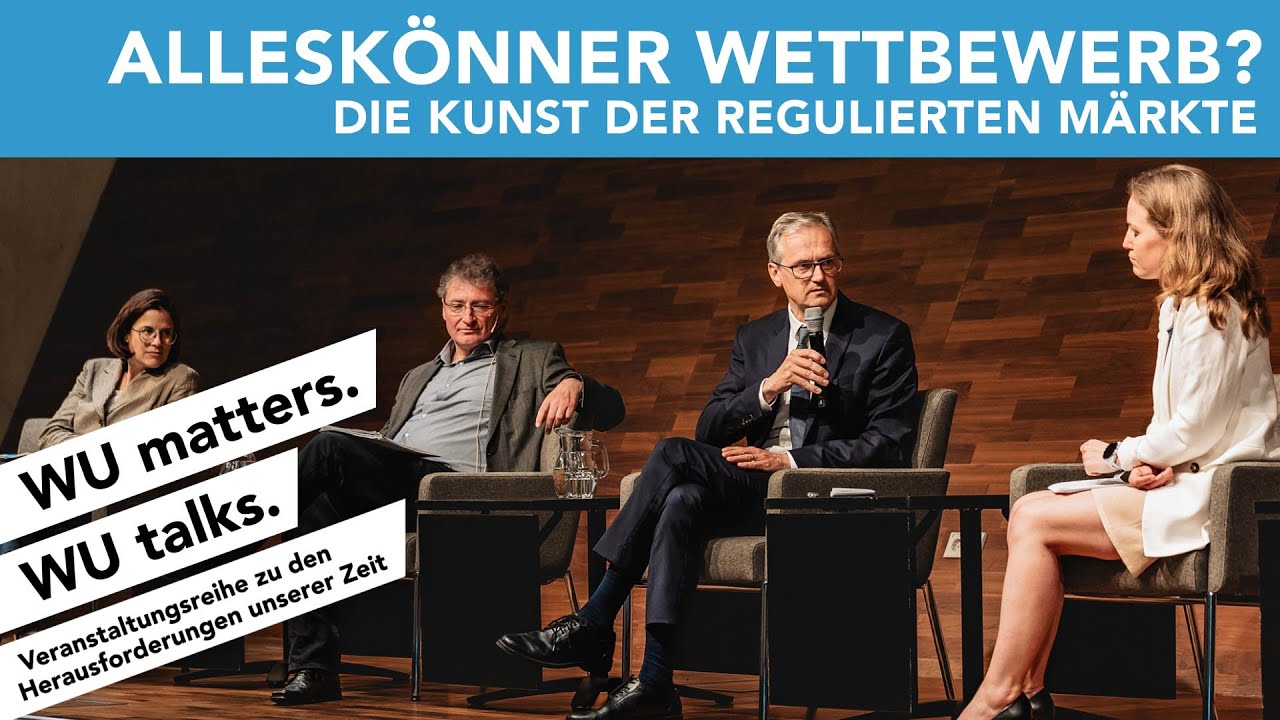
The work of competition authorities is more complex today than ever before. Regulators have to reconcile the diverse challenges posed by big tech, sustainability, supply security, and sanctions regimes. At the same time, the competitiveness of the European single market is at stake. What does all this mean for competition regulation? And what does it take for the balancing act between independent enforcement, democratic control, transparent decision-making, and a dialog with political leaders and society to succeed?
Discussion
Claudia Fuchs, Head of the Institute for Austrian and European Public Law, WU Vienna
Klaus Gugler, Professor at the Department of Economics and Head of the Research Institute for Regulatory Economics, WU Vienna
Natalie Harsdorf, Director General of the Austrian Federal Competition Authority
Wolfgang Urbantschitsch, Member of the Board of Directors of E-Control and Professor at the Institute for Austrian and European Public Law, WU Vienna
Moderated by
Michael Holoubek, Chair of the Department of Public Law and Tax Law and Professor at the Institute for Austrian and European Public Law, WU Vienna
EU matters – Europe in the Ranking of Powers
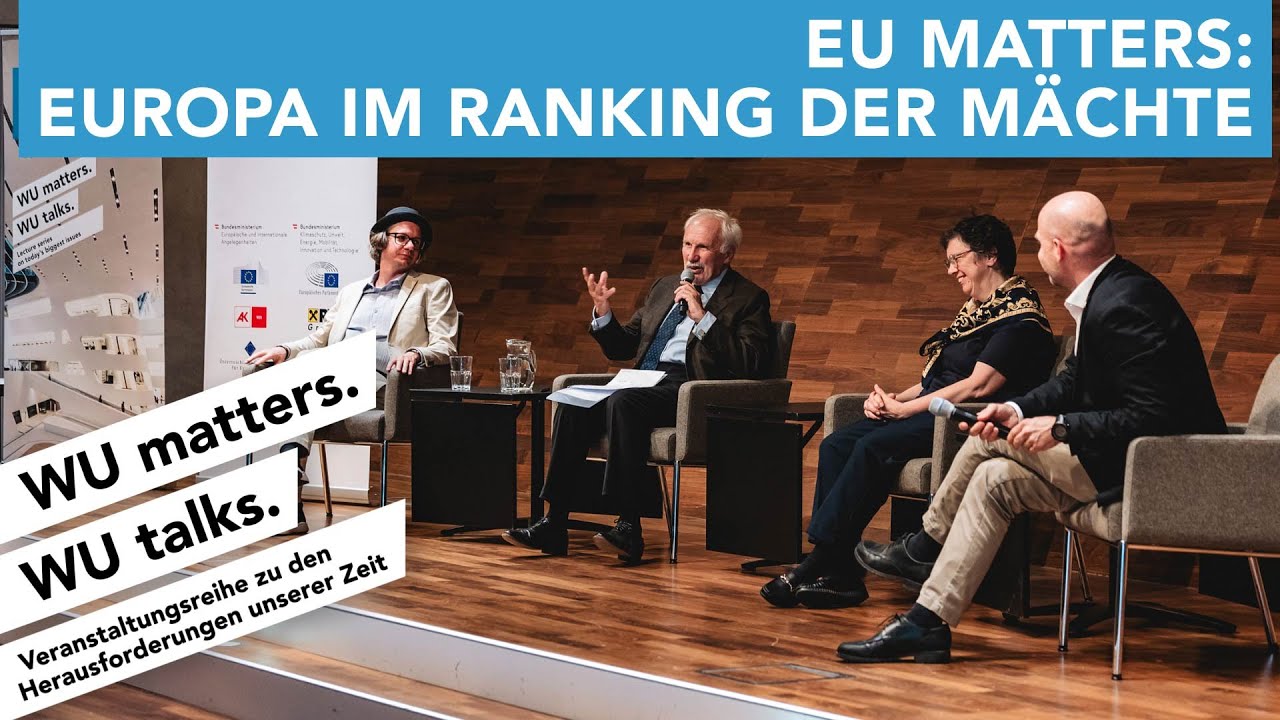
The global economy is in upheaval. Where does Europe stand in the world economy, and where is it headed? To remain competitive internationally, Europe needs reforms, and it needs to invest in the right steps forward. How can we finance the climate and energy transformation, a European defense architecture, and the further development of cutting-edge industries? How will Europe have to change? What kind of enlargement policy is needed for Europe to assert itself in the new world order? And is there even enough political will to drive the necessary reforms?
Lecture
Harald Oberhofer, Professor of Empirical Economics, WU; Senior Economist, WIFO
Discussion
Ewald Nowotny, ÖGfE President and former Governor of the Oesterreichische Nationalbank
Harald Oberhofer, Professor of Empirical Economics, WU; Senior Economist, WIFO
Monika Rosen, stock market expert and Vice President of the Austro-American Society
Moderated by
Paul Schmidt, Secretary General, Austrian Society for European Politics