
BBE Spezialization Supply Chain and Operations Management (SCOM)
The whole business world consists of supply chains! Students that show interest in how products or services originate in a global environment and how they reach their customers in an efficient and effective manner will find their answers in SCOM. Furthermore, students that have already gathered first practical experiences in Supply Chain and Operations Management can deepen their knowledge in this specialization. Good quantitative and methodological skills are as expected from the applicants as motivation, communication and cooperation skills.
SCOM covers all topics related to Supply Chain and Operations Management. These include, among many others, materials procurement, manufacturing of products and the distribution to the customers.
The students – first – receive a broad common body of knowledge in the mandatory Course 1 to 3 dealing with topics of Supply Chain and Operations Management while at the same time working with different methods, tools, and systems to apply the knowledge hands-on.
In the second part of the elective courses, students can focus their interests onto different special topics in Course 4, e.g. International Supply Chain Operations, Service Operation Management or Supply Chain Planning. The last Course 5 is a research seminar, which explicitly aims to enable student to write a Bachelor Thesis in the field of Supply Chain and Operations Management.
BBE Course Overview WS2026/27
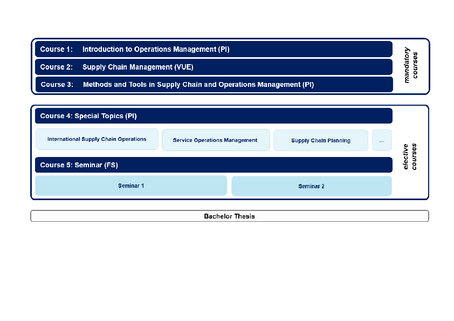
Given the broad knowledge base that the students of SCOM receive the path is open to careers in many different fields. These range from experts in manufacturing and logistics operations to sourcing and procurement specialists as well as inventory and distribution managers.
SCOM is a joint offer by the Institute of Transport and Logistics Management (ITL) and the Institute for Production Management (PM). ALL Courses are offered EACH semester.
So far, we have NO special application procedure, and offer admission to SCOM EACH semester following a first-come-first-serve principle after signing up via @myWU in Access to Specializations: Supply Chain and Operations Management (see https://vvz.wu.ac.at/cgi-bin/vvz.pl?C=S&LANG=EN&S=26W&I=0977)
You can find all further information on our website about the Access to the Specializations, see https://www.wu.ac.at/en/students/my-program/bachelors-programs/business-and-economics/structure-content/access-to-the-specializations
Courses in WS2026/27
Course 1: Introduction to Operations Management (PI, obligatory course)
Assoz.Prof PD Dr. Emel Arikan Fichtinger, M.Sc., Dr. Stefan Treitl
The course provides an introduction to Operations Management (OM) with a focus on manufacturing industries but also including examples from service industries. The basics of Process- and Inventory Management as well as Supply Chain Planning are introduced. The following topics are covered.
Operations Management and Process Analysis
Capacity Management
Inventory Management
EOQ model
Newsvendor model
Multi-period inventory control
For full syllabus see: https://vvz.wu.ac.at/cgi-bin/vvz.pl?C=S&LANG=EN&S=26W&I=1326
Course 2: Supply Chain Management (VUE, obligatory course)
Adel Aazami, Ph.D.
In this course, the essence of supply chain management in success of a business is emphasised, and it aims to provide the students a good understanding of developing and managing supply chains in line with the needs of the business.
The course starts with basics of supply chain management, giving some insights in the areas of purchasing, operations and logistics. The concept of supply chain strategy and its impact on the financial performance of companies is introduced, presenting in detail the characteristics of lean, agile and hybrid supply chain strategies. To facilitate the comprehension of these topics real company examples are provided.
After the completion of this course, the students will:
be able to comprehend the key concepts of supply chain management in practical world and their correlation with business strategy and operations of companies
learn to identify the competitive advantages that can be derived from superior supply chain management
be well versed with supply chain management best practices and obtain an acumen to plan, design and configure an effective supply chain network
For full syllabus see: https://vvz.wu.ac.at/cgi-bin/vvz.pl?C=S&LANG=EN&S=26W&I=1801
Course 3: Methods and Tools in Supply Chain and Operations Management (PI, obligatory course)
Dr. Stefan Treitl
This course addresses the practical application of quantitative methods and software tools to solve current Supply Chain and Operations Management problems. All sessions are held as BYOD classes, centred on implementing and applying spreadsheet and optimization tools to business problems in (up to) three areas:
Supply Chain Network Design
Production Planning and Scheduling
Supply Chain Risks and Risk Management (depending on progress)
Upon completion, students can (1) explain the theoretical methods underlying core SCOM problems, (2) implement and apply appropriate software tools to solve these problems, and (3) analyse, assess, and critically argue the validity and limitations of the results.
For full syllabus see: https://vvz.wu.ac.at/cgi-bin/vvz.pl?C=S&LANG=EN&S=26W&I=2082
Course 4: International Supply Chain Operations (PI, elective course)
Dipl.-Vw. Dr. Hans-Joachim Schramm
This elective course is about managing supply chains outlining operational aspects of transportation, logistics and supply chain management on a global level. A focus will be placed on the trade environment, export/import regulations, customs management, and trade facilitation. Furthermore, an introduction into trade management, including contracting issues, documentary paperwork, Incoterms® as well as means and modes of payment including the impact of digitization and digitalization is provided. Moreover, an insight into the highly relevant subjects of risk, security, and compliance management is given. The course will finish with the topic of transport management that includes organization of international good movements and multimodal transport operations. The course is held in six sessions structured as follows:
Trade Environment: Legal framework of trade and export/import regulations
Customs Management: Customs practices and trade facilitation
Risk, Security, and Compliance Management
Trade Management: Contracting issues, trade terms (esp. Incoterms 2020)
Transport Management: Organization of international good movements
Wrap-up: Process Models and Transport Management Issues
For full syllabus see: https://vvz.wu.ac.at/cgi-bin/vvz.pl?C=S&LANG=EN&S=26W&I=0209
Course 4: Service Operations Management (PI, elective course)
o.Univ.Prof. Dr. Alfred Taudes, Jorao Gomes Junior, MSc
This course deals with the production and delivery of services. Services differ from physical goods. They typically are intangible and are not storable, not transportable and highly variable. These characteristics pose special problems when managing the operations of service operations. This course covers a mix of topics with an emphasis on simple quantitative methods and strategic frameworks. Course outline and plan is as follows:
Nature of Services and Service Strategy
Service Quality, New Service Development, Technology
Service Process Management
Service Process Management Case Presentation
Service Facility Location
Matching Supply and Demand
Waiting Line Management and Personnel Management
For full syllabus see: https://vvz.wu.ac.at/cgi-bin/vvz.pl?C=S&LANG=EN&S=26W&I=0773
Course 4: Supply Chain Planning (PI, elective course)
N.N.
This course covers three planning hierarchies: tactical and operational planning problems in inventory management, and strategic network planning. It focuses on identifying problem types and finding the most relevant information in the problems in order to formulate the problems to assist decision-making. Students are exposed to concepts and models important in inventory planning with emphasis on key trade-offs and phenomena. The following topics are discussed:
Strategic network design
Single-period inventory modelling: The Newsvendor framework
Two extensions of the Newsvendor
Reactive capacity (Dual sourcing model)
Supply chain coordination
Multi-period inventory modelling (Replenishment Policies)
Periodic review and base stock policy
Continuous review and fix order quantity policy
Inventory Pooling effects
For full syllabus see: https://vvz.wu.ac.at/cgi-bin/vvz.pl?C=S&LANG=EN&S=26W&I=0715
Course 4: Introduction to Computer Simulation (PI, elective course)
Dipl.-Ing. Bernhard Oberegger
This course introduces simulation modelling with a focus on discrete-event simulation, system dynamics, and agent-based modelling. These approaches are applied to problems in operations management, logistics, and supply chain network design to visualize real-world processes and support forecasting and optimization. Core concepts such as queueing theory, data collection and analysis, probability distributions, and Monte Carlo simulation provide the theoretical foundation. Students learn simulation modelling techniques and output analysis methods, enabling them to develop, analyse, and experiment with their own models. Simulation models are developed using the AnyLogic PLE software. Therefore, the course is conducted entirely as a computer-based class.
For full syllabus see: https://vvz.wu.ac.at/cgi-bin/vvz.pl?C=S&LANG=EN&S=26W&I=1706
Course 4: Sustainable Operations (PI, elective course)
Prof. Dr. Christoph Schmidt
In this course the students will learn the basic concepts of sustainability in the context of Operations and Supply Chain Management. After completing the course, students will be able to understand the basic concepts of the triple bottom line (economic, social, environmental pillars). They will have a deeper understanding of environmental and social sustainability concepts, including their differences and drivers in global operations and supply chains. Students will critically reflect on the interactions between economic, environmental, and social systems in a global setting. They will be able to apply these concepts in different contexts of supply chain and operations management. Through a group project, students can also critically evaluate what sustainability activities firms, and their supply chains engage in in practice. They will assess these practices using the Global Reporting Initiative (GRI) sustainability reporting standards. They will present and discuss their findings in class, helping them to build and strengthen their English communication and presentation skills.
For full syllabus see: https://vvz.wu.ac.at/cgi-bin/vvz.pl?C=S&LANG=EN&S=26W&I=0570
Course 5: Seminar 1: Supply Chain Management in International Context (FS)
Adel Aazami, Ph.D., Ioanna Falagara Sigala, Ph.D., Dipl.-Vw. Dr. Hans-Joachim Schramm
After successful completion of this course, students should be able:
to assess, define, structure and solve stepwise a research problem from the field of transport and logistics.
to prepare, present and discuss a research proposal, including outline and research design.
to identify, judge qualitatively and balance suitable sources for a research problem.
to choose a suitable research and analysis method for his/her concrete research problem and apply it correct mostly autonomous.
to end in a solution of the research problem, wrap up results accordingly and interpret them technically correct and conclusive.
to write, present and defend a self-contained scientific research work
For full syllabus see: https://vvz.wu.ac.at/cgi-bin/vvz.pl?C=S&LANG=EN&S=26W&I=0275
Course 5: Seminar 2: Research Seminar in Operations Management
Univ.Prof. Mag.Dr. Gerald Reiner, Assoz.Prof PD Dr. Emel Arikan Fichtinger, M.Sc., Assoz.Prof PD Lena Silbermayr, Ph.D.
This Seminar Course deals with special topics in Operations Management. It shall support you in the process of academic writing, be it seminar papers, bachelor theses or master theses. We will provide you with some ideas for deepening your knowledge in the manifold field of Operations Management. In the course of this lecture, you will then create your own seminar paper, thereby learning and applying the basic rules of academic writing. After successful completion of the seminar, you should be able to critically evaluate and discuss published results from the literature. Furthermore, you should have acquired the skills to write an academic paper of high quality and to present your work effectively.
For full syllabus see: https://vvz.wu.ac.at/cgi-bin/vvz.pl?C=S&LANG=EN&S=26W&I=2569