![[Translate to English:]](/fileadmin/wu/_processed_/2/b/csm_108-Laptop-960_v1_6459697f76.jpg)
News
Advancing the Green Hydrogen Policy Debate at the World Hydrogen Energy Conference in Sinagpore (20-26 June 2026)
Christian Rumpelnik presented his paper (together with Kavita Surana and Behnam Zakeri) “Spatially-informed Demand-side Policies for Green Hydrogen Diffusion in Europe” at the World Hydrogen Energy Conference in Singapore, a global forum of academics, policymakers and business representatives.
Exploring the New Global Economic Order at the I.S.E.O. Summer School (13–20 June 2026)
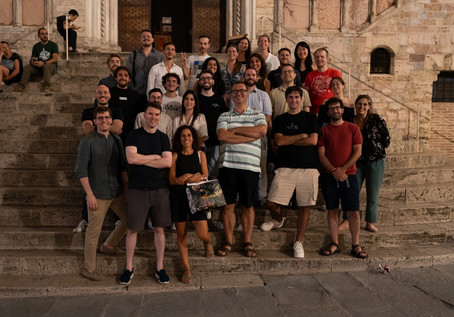
Damiano Alessi joined 100 participants from 41 countries at the 22nd I.S.E.O. Summer School in Iseo, Italy, for an intensive week on The New Global Economic Order, with lectures by Nobel Laureates James J. Heckman and Michael Spence, and other leading scholars. He also presented his research during the School's Poster Session.
Presenting energy research at the ETH PhD Academy on Sustainability and Technology (31 May–5 June 2026)
Damiano Alessi participated with 15 international early-career researchers in the 2026 ETH Zurich PhD Academy on Sustainability and Technology, themed Energy Research in a Changing World. He presented his research to an international faculty, including Profs. Inês Azevedo (Stanford), Varun Rai (UT Austin), and Alejandro Nuñez-Jimenez (ETH Zurich).
Green industrial policy, social science, and justice and equity at EGU May 6, 2026
Kavita Surana co-convened the European Geosciences Union General Assembly session "Advancing Justice and Social Science Integration in Climate Modeling" (Vienna, 3–8 May), which also features an IDEaS poster on nascent value chains of climate mitigating technologies. See more: Session ITS3.6/ERE6.5.
Mapping geoeconomic scenarios for renewable hydrogen in industry April 22, 2026
Kavita Surana co-authored a Perspective in Nature Reviews Clean Technology that examines how renewable hydrogen could reshape industrial value chains and the geography of production. It maps three scenarios — fuel switch, industrial relocation, and hybrid co-location — and their geopolitical, environmental, and justice implications. Read the paper here.
Examining entrepreneurship in energy innovation April 2026 - Kavita Surana co-authored the chapter "Energy technology entrepreneurship" with Claudia Doblinger (TU Munich) in the Handbook of Energy Innovation (Edward Elgar), edited by Laura Diaz Anadon, Abhishek Malhotra, Ambuj D. Sagar, and Elena Verdolini. Read the chapter here.
Advancing Science Communication in an Era of Complex Risk (24 March 2026)
IDEaS recently welcomed Prof. Lisa Palmer, a Journalist in Residence from the International Institute for Applied Systems Analysis (IIASA), for a seminar on “Science Communication in an Age of Complex Risk.”
The session explored a key challenge facing science today: evidence alone does not necessarily lead to action. The seminar highlighted evolving approaches to science communication, including the role of narratives, risk framing, and engagement strategies in bridging the gap between research and societal impact.
A central theme of the discussion was the need to build communities of practice that strengthen communication capabilities across disciplines. Participants reflected on how researchers and journalists can better collaborate to reach broader audiences and enhance the visibility and relevance of scientific work.
The visit sparked ideas for future collaboration between WU and IIASA, reinforcing the importance of effective science communication in addressing complex global challenges.
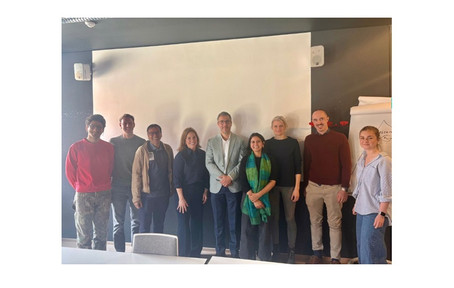
WU Launches New Course on AI and Environmental Sustainability
March 2026 – The WU Vienna University of Economics and Business has introduced a new bachelor-level seminar, “AI and Environmental Sustainability,” within the Responsible Management of Information Systems (RMIS) specialization.
Offered for the first time in Spring 2026 by IDEaS’ Dr. Zakeri, the course examines the environmental impacts of artificial intelligence, from resource demands of data centres to broader system-wide effects on sustainability. Students critically assess both the risks and opportunities of AI, linking real-world applications to environmental indicators and the United Nations Sustainable Development Goals (SDGs).
More info: https://learn.wu.ac.at/dotlrn/classes/pool/4098.26s
First team retreat (January 2026): The IDEaS team came together to define the institute's vision, research focus, and goals for the year ahead.
Network structure matters: how coordination and cooperation mechanisms drive solar-battery co-adoption (January 9, 2026): Kavita Surana co-authored a new paper in Environmental Research Letters finding that the structure of local governance networks—how stakeholders coordinate and collaborate to support energy transitions—significantly influences household solar-battery co-adoption across eight U.S. states. Dense cooperative ties among stakeholders matter more than information-sharing alone, offering concrete guidance for policy entrepreneurs seeking to accelerate clean energy adoption.
AGU 2025 (December, 2025): Damiano Alessi also presented a poster at the AGU 25 (American Geophysical Union) meeting in New Orleans, USA. Contributing to the Macroenergy Systems group, he presented his work on "Timelines and Delays in European Grid Expansion." The session offered a valuable opportunity to discuss the systemic challenges of scaling power grids to meet climate targets within a highly international and multidisciplinary environment.
Informed investments in clean energy technologies (November 24, 2025): Kavita Surana co-authored a perspective inNature Energy with a team of leading international researchers on how research insights can inform government and corporate decisions on energy technology R&D and deployment. The paper outlines three key steps—forecasting technological change, linking investments to outcomes, and improving decision-making—and recommends advances in model validation, streamlining, and interactivity.
Dr. Zakeri delivers a talk on Environmental Impact of DIgitalisation as part of Future Foundations Talk Series (10 November 2025)
The first Future Foundations talk, held on 10 November 2025 in cooperation with WU Vienna University of Economics and Business, focused on the 5th Rule for the Digital World: “Do not destroy life and nature for technical progress.”
Dr. Behnam Zakeri, Assistant Professor at IDEaS, addressed the question: What is the real environmental impact of digitalisation? His talk highlighted that while digital technologies can support sustainability, their rapid growth, especially AI, comes with significant energy, water, material, and infrastructure demands. A key takeaway was the need to rethink how AI is used and where it may intensify resource scarcity and distributional effects.
The event, hosted by Prof. Sarah Spiekermann-Hoff, received attendance from several WU departments and external audience, and opened an important discussion on balancing digital innovation with environmental responsibility, setting the tone for the Future Foundations series.
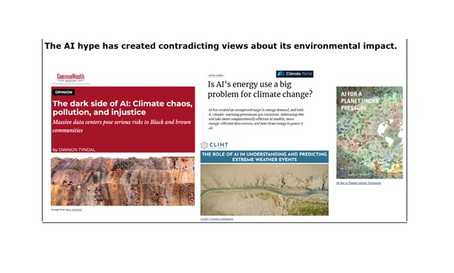
9th AIEE Energy Symposium on Energy Security (November, 2025): Damiano Alessi recently participated in the 9th AIEE Energy Symposium on Energy Security, organized by the Italian Association of Energy Economists (AIEE) in Rome. This international forum focuses on the evolving challenges of global energy markets and security. During the symposium, Damiano presented the research project "Timelines and Delays in European Grid Expansion", a joint work with Kavita Surana and Behnam Zakeri.
SDEWES 2025: Christian Rumpelnik participated in the 20th edition of the SDEWES (Sustainable Development of Energy, Water and Environment Systems) in Dubrovnik, Croatia. He presented is ongoing work (together with Kavita Surana and Behnam Zakeri) on spatially informed, demand-side policies for green hydrogen deployment in the energy system analysis section. The conference offered the opportunity to exchange with an international group of scholars working on topics in energy, sustainability and sustainable development.
Catching CO2 with data (October 2025): Prof. Kavita Surana was featured in WU Vienna's MORe – Meet Our Researchers series, highlighting her work on modeling climate technology growth pathways and the role of public and corporate investment in scaling climate innovation.
Clean energy transition at WU matters. WU talks. (October 29, 2025): Prof. Kavita Surana delivered a public lecture at WU Vienna's WU matters. WU talks. series on the clean energy transition — covering how innovation involving technology, policy, and investment can advance both climate action and economic development, including implications for global energy value chains and local prosperity. Read more here
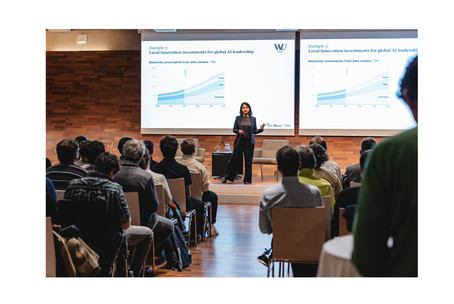
Energy innovation and value chains (September 4, 2025): Prof. Kavita Surana delivered an invited keynote lecture at the ETH Zurich Energy Summer School, "Navigating the Energy Transition in an Insecure World," held in Ascona, Switzerland. Her talk explored how startups and specialized firms shape clean energy value chains, and what public and private sector strategies are needed to accelerate energy innovation from early-stage research to deployment.
IDEaS predocs at ETH Zurich Energy Summer School 2025 (September 2025): Damiano Alessi, Robin Fischer, and Christian Rumpelnik participated in theETH Zurich Energy Summer School in Ascona, Switzerland. Damiano Alessi received the best poster award for his research on timelines and delays in European grid expansion.
Assessing innovation in the nascent value chains of climate-mitigating technologies (August 29, 2025). Kavita Surana co-authored a paper in Environmental Research Letters analyzing nearly 13,000 early-stage investments in over 3,600 North American climate-tech firms between 2006 and 2021. The paper conceptualizes nascent value chains in 14 climate-tech sectors, finding that only 15% of firms develop end products, while the rest support through components, manufacturing, optimization, and business services. Three patterns of innovation emerge—maturing, ongoing, and emerging—with implications for policy design that supports full value chain development rather than only end products.
Impact of energy prices on the decarbonisation of the EU’s building sector [Oct 2024]
The dramatic increase in end-use energy prices in the EU in 2022-2023 has intensified the debate on how these prices may or may not contribute to the decarbonization of the building sector. Dr. Zakeri and a group of researchers from Technical University Vienna (TU Wien) have investigated this question using data-intensive, model-based simulations of all EU Member States’ building sector in 2020-2050. The results underscore that while stringent regulatory measures can achieve significant energy savings and reduce greenhouse gas emissions, they also limit the responsiveness to price signals and as such the impact of prices on the choice of technology. For more details, please refer to https://www.sciencedirect.com/science/article/pii/S0378778824009307.
How can we store hydrogen affordably at a large scale? [Sep 2024]
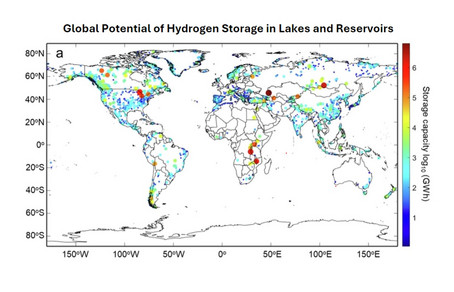
(Green) hydrogen is considered to be one of the enablers of net-zero energy transitions. As such, many world regions such as the EU have rolled out policies and incentives to scale up hydrogen projects. However, hydrogen storage remains a challenge, especially for long periods (e.g., from summer to winter) and at a large scale. Behnam Zakeri and a group of international researchers explored a new solution for storing hydrogen in lakes and water reservoirs. They estimated potential sites for this new storage solution globally including the cost of storage. The work is published in Nature Communication, including the open access to the accompanying global dataset. More information can be found here: https://www.nature.com/articles/s41467-024-52237-1
Net-zero pathways across the Atlantic: What Europe and the US can learn from each other (Aug 2024)?
Behnam Zakeri and a group of international researchers explored the net zero pathways of Europe and the United States (US) through a multi-model comparison exercise that includes more than 28 integrated assessment and bottom-up energy models. The study was supported by the European Climate and Energy Modeling Forum (ECEMF) examined net zero scenarios by mid-century in both regions in line with the 1.5◦ goal of the Paris Agreement, highlighting differences and similarities arising from modeling assumptions, technology projections, and implemented policies. The related publication can be found here: https://www.sciencedirect.com/science/article/pii/S2666278724000205
Econometrics meets Natural Language Processing: from Topic Analysis to Large Language Models (July 22-26, 2024): Damiano Alessi participated in the summer school in Perugia organized by the Italian Econometric Association. The program aimed to bridge the gap between econometrics and natural language processing (NLP), guiding participants from foundational concepts of topic analysis to cutting-edge advancements in large language models (LLMs). This comprehensive course provided valuable insights and practical skills applicable to both fields.
Machine learning for sustainable development and climate action: Estimating growth in global rooftop area by 2050 (July 17, 2024): Behnam Zakeri supervised a research project on developing a machine learning framework that uses big data from about 700 million building footprints, global land cover, global road, and population information to estimate of rooftop area growth from 2020 to 2050 under different future scenarios. The dataset has been published in the journal Nature Scientific Data, demonstrating an innovative application of AI for decentralized energy planning, urban and land use planning, disaster management, and climate action. More info in press releases in English and German.
Morgan Edwards from the University of Wisconsin-Madison, USA visits IDEaS (June 24 – June 28, 2024): Prof. Morgan Edwards was a visiting scholar at the institute and worked with Kavita Surana and Damiano Alessi on ongoing papers and future projects related to climate and energy innovation policy and climate action.
Rapid rise in corporate climate-tech investments complements support from public grants (June 18, 2024): Kavita Surana co-authored a policy brief in Nature Energy with results from her recent paper written for a policy audience. The policy brief emphasizes the role of public-private partnerships for supporting and scaling climate and energy startups and notes what policymakers at the national and sub-national levels can do to incentivize such partnerships.
Maximizing the contribution of aviation to 2050 net-zero emission reduction pathways through evidence-based policy (June 9 – June 12, 2024): Kavita Surana presented research on decarbonizing aviation at the What Works Climate Solutions Summit (WWCS) in Berlin, Germany. The paper builds a novel evidence base combining data on aviation start-ups, corporate commitments, demonstration projects, and demand side measures (e.g., mode-shifting to railways) and combines it with a sectoral and integrated assessment model to evaluate how policy action scenarios can accelerate emissions abatement in the aviation industry.
The State of Carbon Dioxide Removal (June 4, 2024): Kavita Surana contributed to the 2nd edition of the State of Carbon Dioxide Removal (CDR) report for Chapter 3: Demonstration and Upscaling. The report offers an independent scientific assessment of CDR developments around the world.
The evolution of sustainable markets and innovation (June 3-4, 2024): Kavita Surana participated in a workshop held at the Technical University of Munich, Science and Study Center in Raitenhaslach, Germany. She presented her work on public-private investments for sustainable innovation and markets focusing on the growing role of large corporations.
Accelerating Innovation in the Global Value Chains of Clean Energy Technologies (May 22, 2024): Prof. Surana was invited to give a talk at the ETH Zurich Colloquium on Science, Technology, and Policy. Her talk focused on how countries can achieve both climate and economic goals through innovation and industrial policy, drawing on lessons from the wind energy industry.
The effects of corporate investment and public grants on climate and energy startup outcomes (May 15, 2024). Prof. Surana’s new co-authored paper in Nature Energy highlights that startups matter for scaling climate and energy innovation, and public funding matters for startups especially in challenging sector. In addition, strategic corporate investors play a key role in complementing publicly funded startups and improve IPO / M&A rates by 155% compared to 78% from other private / venture capital investors. Read the press release here.
Modeling direct air carbon capture and storage in a 1.5 °C climate future using historical analogs (May 6, 2024): Prof. Surana’s new co-authored paper in the Proceedings of the National Academies of Sciences (PNAS) finds that direct air capture with carbon storage could be a key tool to combat climate change and help remove nearly 5 Gt of CO2 by 2050 if it follows the path of rapid-growth tech such as solar PVs. Read the press release here.
A Software Billionaire Is Betting Big on a Wild Climate Fix (April 16, 2024): Prof. Kavita Surana was quoted in an article in Bloomberg on Mike Cannon-Brookes, the co-founder of software giant Atlassian, and his plans for climate and energy innovation that could transform power grids.
Science for Policy Podcast: Using Scientific Models for Policymaking (March 25, 2024): Behnam Zakeri joined an expert panel discussing the role of scientific models for informing energy, land use, and air pollution policymaking. The podcast was organized by Scientific Advice Mechanism to the European Commission (EC), and the key topics discussed included “How do scientific models inform policymakers? How can they keep countries honest in international climate negotiations? When is uncertainty not so much of a problem? And how much does it matter if policymakers don't instantly grasp the model technicalities?”.
Leading for a sustainable future (February 29, 2024): Cisco CEO Chuck Robbins and panelists, including Prof. Kavita Surana, discussed sustainability in technology and technology for sustainability at a WU event titled “Leading for a Sustainable Future”. They highlighted the urgency of addressing the climate crisis, the role of academia and businesses, and the potential of AI and digital technologies to improve quality of life and reduce environmental impact. Read more here.

Institute launch (February 1, 2024): The Institute for Data, Energy, and Sustainability was launched on February 1, 2024!