FLAIR Erasmus+ Project
An international consortium with six partner universities has launched the FLAIR project with the aim of supporting teachers in conveying AI literacy as well as developing tools for students to acquire AI skills through self-learning.
FLAIR is co-funded by Erasmus+ and stands for Fostering Learners' AI Readiness. The project runs from the beginning of October 2024 to the end of November 2026 and is divided into three major work packages.
Results
The FLAIR consortium can already look back on concrete results after the first project year. The most important results that have been published are:
Six National Reports: AI Competence Frameworks and Policies in Higher Education: Analysis and Recommendations
Synthesis Report: AI Competence Frameworks and Policies in Higher Education
1st FLAIR Dissemination Event | 16 - 17 October 2025
Mid-October, WU Vienna welcomed around 100 participants from more than 14 countries for the first FLAIR Dissemination Event in conjunction with the Seamless Learning Conference.
Over the course of two days, researchers, educators, and practitioners shared research outcomes, project insights and ideas on how AI is reshaping higher education. As the field of AI in education is highly dynamic, the FLAIR consortium deliberately decided to hold an early dissemination event, after just 1 year of working together. This has enabled the consortium to engage in dialogue, validate previous results, and consider new developments in upcoming deliverables.
One of the three conference tracks addressed a central question of the FLAIR project: How can AI competences be meaningfully fostered in higher education – for both learners and teachers? It showcased five inspiring international contributions, including case studies from HEIs as well as global and international initiatives to empower students and teachers with AI skills, which inspired lively discussions among the participants.
A major highlight of the Seamless Learning Conference was the closing plenary session with all FLAIR partners. Based on the published National Reports and the Synthesis Report, the partners presented lessons learned from the systematic exploration of different national and institutional approaches to fostering AI literacy and skills development in higher education. The panel provided insights into national approaches in Estonia, Spain, Ireland, Austria, the Netherlands and Turkey, and discussed existing AI competence frameworks and their limitations. The discussion vividly illustrated both the diversity of approaches across Europe and beyond, as well as the common challenges faced by higher education worldwide.
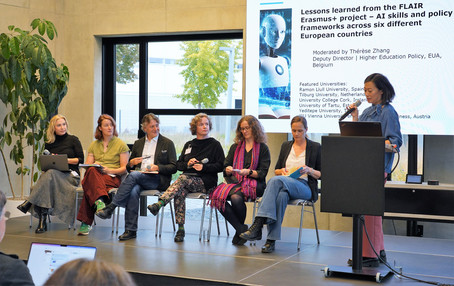
© Matyas Szabo
Project Summary
| ⇒ Objectives |
| The sudden public availability of generative AI tools has acted as a catalyst for changes in pedagogy and learning. FLAIR will contribute to preparing learners to thrive in a society characterized by digital transformation by promoting an ethical and meaningful use of generative AI, thus fostering students’ AI readiness. Overall, FLAIR will provide insight into the ongoing discourse on AI literacy in Europe, contribute to the advancement of AI literacy education and promote transversal skills. |
| ⇒ Implementation |
| Initially, comparative research on AI literacy frameworks, guidelines and policies will be carried out, contributing to an overview of European approaches. Two different approaches will then be developed to support learners in acquiring the necessary skills to use genAI responsibly and efficiently. These will include versatile and adaptable self-learning modules for students and transdisciplinary learning activities that are ready to use and can be embedded in existing courses. |
| ⇒ Results |
| The research conducted in Phase 1 will result in a synthesis report that will form the basis of an AI skills framework identifying key transferable skills. Phase 2 will develop a blueprint and a comprehensive library of materials to enable educators to adapt the self-learning modules to their needs. In phase 3, a toolkit for lecturers will be published, focusing on skills that need facilitation. It will be complemented by learning nuggets ready to be embedded in courses in various disciplines. |
Overview Work packages
Work package 1: Program Management
Work package 2: AI literacy framework, national reports and a synthesis report
Work package 3: Self-learning modules: Blueprint, Materials Library
Work package 4: Didactic Framework, Teaching Toolkit and Learning Nuggets
Project Consortium
| Vienna University of Economics and Business (Project Lead) | Austria | Johanna Warm, Oliver Vettori, Hedda Guggenberger |
| Ramon Llull University | Spain | Elisabet Golobardes, Xavier Vilasís |
| Tilburg University | Netherlands | Nikos Basbas, Matthijs van Gils, Frea van Dooremaal |
| University College Cork | Ireland | Loretta Goff, Sarah Thelen |
| University of Tartu | Estonia | Helen Hint, Djuddah Leijen, Krista Lepik-Verliin |
| Yeditepe University | Turkey | Berrin Yanikkaya, Ege Simge Demirel |

Fostering Learners' AI Readiness