
Bachelor and Master Thesis at IfSTO
The IfSTO team is happy to supervise your bachelor´s or master´s thesis. You can find current topics for a thesis, information about the process and necessary forms on this page.
If your topic has innovation at the core of the research question, it will constitute a good fit with the institute. The research focus of the institute revolves around Open and User Innovation and we particularly welcome theses in this field. It is, however, not a must. Specifically, we are interested in the following topics:
The Role of Influencers for the Diffusion of Innovation
The Role of AI for Innovation
New Organizational Forms for Innovation
Behavioral and Technique Innovation
Below you will find a list of current topics (topics marked with a Bachelor are for bachelor theses, with an Master for master theses only and Bachelor / Master for both bachelor and master theses). Besides these topics, feel free to come up with your on suggestions! If you have alternative topics with innovations at their core or other topics that relate to our research interests, feel free to contact at us.
Currently offered bachelor's and master's theses:
Call for Master Theses at IfSTO (October 2026)
Call for Master Theses at IfSTO (October 2026)
Dear students,
The Institute for Strategy, Technology and Organization is currently looking for students who want to write their bachelor or master thesis at our institute with a focus on innovation. Your thesis may relate to how individuals or organizations create and capture value through innovation in the digital age. Research areas can include, but are not limited to the following three interrelated areas:
The paradigm shift towards open, user-centered and democratized innovation processes.
The role of digital technologies such as artificial intelligence and/or machine learning for innovation processes: what role may such digital technologies play independently or in collaboration with human intelligence in different phases of the innovation process such as need recognition, ideation, evaluation & testing, development, and diffusion.
New forms of organizing innovation allowing organizations to rapidly adapt in highly dynamic and uncertain environments.
If you are interested in one of these areas please shortly draft on 2-3 pages an outline/essay along the lines given here and send this per email to Christopher.Lettl@wu.ac.at
[Bachelor/Master]: Applied AI in Strategy & Innovation
Dear students,
Strategic decisions increasingly rely on AI-enabled prediction, automation, and algorithmic control: from allocating budgets and talent to prioritizing R&D, to shaping how platforms rank, match, and price. Working effectively in this space takes more than “running models”: it requires clean measurement, credible research design, and the ability to translate technical choices into strategic implications. This thesis track is designed for students who want to acquire strong quantitative expertise and produce a quantitative thesis at the intersection of Applied AI, Strategy & Innovation, potentially also in applied domains such as Health, AI for Good, the public sector, or education, as long as there is a clear strategy or innovation angle.
Example topics (own topic proposals are welcome):
AI adoption and sustained advantage vs. Imitation
Delegation to AI and incentive misalignment
AI across the innovation funnel
Effects of ranking/recommendation/matching algorithms on creators, sellers, or users
Platform competition under AI: feature launches, imitation dynamics, multi-homing
How to apply: If you are interested, please email stefan.herytash@wu.ac.at and include 1–5 bullet points on your relevant background, your CV and transcript, as well as your preferred start date and area.

[Bachelor/Master] Gender Gaps in Management, Organizations and Entrepreneurship
The Gender Data Gap describes situations where most of the data behind organizational decisions is biased in favor of men. Such data is often incomplete and unreliable because it lacks information about women’s preferences, fit and circumstances. Examples include devices designed for male handspans, protective equipment designed for male bodies, and informal networking over evening drinks, when women and caregivers are often not present. Understanding these effects is important for designing interventions that achieve gender equality at every level of the organization. We supervise theses in the following areas:
1. The Gender Data Gap and women’s careers (Bachelor)
How does the Gender Data Gap harm women, and organizations as a whole? Possible questions:
How do firm- and industry-level factors contribute to Gender Data Gap effects on women’s careers?
How does the Gender Data Gap affect women’s careers and upward mobility?
To what extent do Gender Data Gaps cause or worsen toxic cultures and workplaces?
2. Rethinking management and organization theory (Bachelor)
What changes when we take the Gender Data Gap seriously in research itself? Possible questions:
How can management and organization theories be extended by making “invisible acts” more visible, for example instrumental work done by women that is neither recognized nor rewarded?
Which assumptions in management and organization studies need revisiting in light of efforts to close the Gender Data Gap?
3. AI and the Gender Data Gap (Bachelor)
AI can raise productivity and operational efficiency, but its success depends on the data it learns from, and persistent data gaps limit it. This thesis examines whether AI will help close the Gender Data Gap or make it worse, and how that affects businesses and their productivity.
4. Gender and start-up success (Bachelor/Master)
Research on start-ups shows that gender, on both the founder and the investor side, can strongly affect whether a start-up gets funding, how it is perceived on the market, and how its success or failure is judged. Women and men also start businesses under different conditions, for example in access to resources and in support from the founder ecosystem (see Kanze, Huang, Conley & Higgins, 2018, AMJ: “We ask men to win and women not to lose”). Theses in this area look at when and why gender makes a difference. Possible questions:
Do investors evaluate the same business idea differently when it comes from an all-male, all-female or mixed team? Why?
Do outsiders, such as the media, judge a successful or failed start-up differently depending on whether the founder is male or female? Why?
What is success or failure attributed to (e.g., market conditions, personal factors such as characteristics or educational background) for male versus female founders?
Master theses can, for instance, analyze newspaper coverage of start-up success.
5. Precarity and the gender gap in top management (Master)
Women are still significantly underrepresented in top executive positions. Known causes include differences in networks and in access to knowledge and social resources. Precarious employment, such as part-time work and fixed-term contracts, is known to harm female workers, but its role in women’s underrepresentation at the top has mostly been overlooked. This thesis explores it with a qualitative (interview) or quantitative study, for example looking at what causes the negative effects or which approaches could reduce them.
Your own research question within these areas is welcome!
How to apply:
Send a short draft with your proposed topic, a specific research question and an outline of the thesis to PD Dr. Sonja Sperber (sonja.sperber@wu.ac.at).

[Bachelor/Master]: The Art of Luxury Innovation
Luxury companies are often associated with heritage, consistency and tradition. However, customers’ call for innovation increasingly also affects those tradition-driven firms. Therefore, a form of innovation that both adheres to those long-standing values of quality as well as the ongoing orientation towards change and newness arises. This bachelor thesis topic can either focus on product- or service-oriented luxury firms and investigates the art of luxury innovation in a qualitative study.
If you are interested in this topic, please send a short draft (max. 1 page) of your proposed topic along with the formulation of a specific research question and an outline for the thesis to Dr. Sonja Sperber (sonja.sperber@wu.ac.at).
[Bachelor/Master] Mapping Makerspaces: characteristics, participants, and innovative potential
Makerspaces are collaborative environments that provide access to tools, technology, and a community of like-minded individuals interested in hands-on creation. They play a crucial role in fostering innovation, knowledge sharing, and entrepreneurial activities. However, despite their increasing presence in the DACH region, little systematic research exists on their characteristics, the types of participants they attract, and their broader impact on innovation and collaboration.
Many open questions remain in this field, and bachelor or master theses could explore topics such as:
What are the key characteristics that differentiate various types of makerspaces in the DACH region?
Who are the typical participants of makerspaces, and what motivates them to engage?
How do makerspaces foster collaboration and knowledge exchange among their members?
What impact do makerspaces have on individual learning, skill development, and entrepreneurial activities?
How can survey and interview data be used to generate a typology of makerspaces?
To address these questions, the research will be based on two complementary approaches:
Survey Study: A structured, quantitative approach to systematically assess the characteristics of makerspaces, their facilities, governance models, and the demographics of their participants.
Interviews with Makerspace Owners and Participants: A qualitative study to explore motivations, collaboration dynamics, and the perceived benefits and challenges of makerspaces.
Depending on the specific research question and methodological preferences, thesis projects could take different forms, including:
Literature reviews: Synthesizing existing research on makerspaces, their role in innovation, and their impact on participants.
Survey-based research: Designing, conducting, and analyzing a survey on makerspace characteristics and participants.
Qualitative interviews/case studies: Conducting in-depth interviews with makerspace owners and participants to explore motivations and collaboration patterns.
Mixed-method approaches: Combining surveys and interviews for a more comprehensive analysis.
If you are interested and would like more information, please contact Florian Nemetz (florian.peter.nemetz@wu.ac.at). If you already have a concrete idea, feel free to send a short draft (max. 2 pages) outlining your research question and methodological approach.
If you are interested, please contact:

[Bachelor/Master] Leveraging LLM-hallucinations for innovation
Large Language Models (LLMs) are increasingly integrated into innovation processes to support ideation, problem-solving, and decision-making. While much research and practice focus on improving the accuracy of these models, their so-called “hallucinations”—outputs that are factually incorrect or speculative—can also hold creative potential.
In some contexts, these unexpected or unconventional responses may inspire new ideas, challenge existing assumptions, or open up novel directions in product and service innovation. Despite this potential, there is little systematic research on how LLM hallucinations can be purposefully leveraged to support creativity and innovation. Understanding their role could provide new insights into human–AI collaboration and expand how organizations use AI in early innovation stages. Many open questions remain in this area, making it a promising topic for bachelor’s or master’s theses, for example:
How do hallucinations differ from intentional creative suggestions in human–AI interaction?
In which ways can LLM hallucinations inspire new ideas, concepts, or problem framings during innovation processes?
How do users perceive and respond to hallucinated outputs in ideation contexts?
What methods or structures can help identify, evaluate, and refine useful hallucinations for innovation purposes?
What ethical and practical considerations arise when intentionally using hallucinations in innovation?
To explore these questions, various methodological approaches can be used:
Literature reviews: Mapping research on creativity, human–AI interaction, and the role of LLMs in ideation.
Experimental studies: Observing how users interact with and respond to hallucinated outputs in innovation settings.
Qualitative interviews / case studies: Exploring how organizations or individuals use unexpected AI outputs as creative triggers.
Mixed-method approaches: Combining qualitative and quantitative methods to understand both mechanisms and outcomes.
If you are interested in this topic or would like more information, please contact Lea Scheiter (lea.scheiter@wu.ac.at).
If you already have a concrete idea, feel free to submit a short proposal (max. 2 pages) outlining your research question and methodological approach.

[Bachelor/Master] Integrating AI on User Innovation Platforms
User Innovation Platforms are digital environments where users collaboratively develop ideas, improve products, and drive innovation. In recent years, AI technologies have begun to play an increasingly important role in these spaces. They can accelerate innovation processes, support creativity, automate feedback, and assist in decision-making. However, little systematic research exists on how AI is actually integrated into such platforms, how it shapes collaboration, and what opportunities and challenges arise for organizations, communities, and individual users. Many open questions remain in this field, and bachelor’s or master’s theses could explore topics such as:
What types of AI technologies are currently being implemented on user innovation platforms, and how do they transform innovation processes?
How does AI affect collaboration dynamics and the distribution of roles among users, companies, and platform operators?
What opportunities and risks do participants perceive when AI is integrated into these platforms?
How does AI influence the balance between human creativity and automated support?
What governance and ethical questions emerge as AI becomes an integral part of collaborative innovation processes?
To address these questions, various methodological approaches can be used, including:
Literature reviews: Synthesizing existing research on user innovation platforms and the role of AI in innovation.
Survey-based research: Designing and conducting surveys to assess perceptions, usage patterns, and impacts of AI features.
Qualitative interviews / case studies: Exploring experiences of users, platform operators, or organizations integrating AI.
Mixed-method approaches: Combining quantitative and qualitative methods for a comprehensive analysis.
If you are interested in this topic or would like more information, please contact Lea Scheiter (lea.scheiter@wu.ac.at).
If you already have a concrete idea, feel free to submit a short proposal (max. 2 pages) outlining your research question and methodological approach.
[Bachelor/Master] User and expert collaboration with AI in New Product Development
New Product Development (NPD) increasingly relies on collaboration between different stakeholders, including users, experts, and organizations. These interactions can generate valuable ideas, accelerate development processes, and lead to more innovative and user-centered products.
With the growing availability of AI technologies, collaboration in NPD is undergoing a fundamental shift: AI can support idea generation, automate routine tasks, facilitate decision-making, and act as a creative partner. However, systematic research is still limited on how AI shapes the collaboration between users and experts in NPD, how roles and responsibilities are redistributed, and what new opportunities and challenges arise for innovation management. Many open questions in this field offer exciting avenues for bachelor’s or master’s theses, for example:
How does AI influence the interaction between users and experts during the different stages of product development?
In which ways does AI act as a facilitator, co-creator, or mediator in collaborative NPD processes?
How do users and experts perceive the value and limitations of AI support?
How does AI integration affect decision-making, creativity, and ownership of ideas?
What skills, structures, or governance mechanisms are needed to make AI-enabled collaboration effective and responsible?
Possible methodological approaches include:
Literature reviews: Mapping and synthesizing research on collaboration in NPD and the role of AI.
Survey-based research: Investigating perceptions, experiences, and outcomes of AI-supported collaboration.
Qualitative interviews / case studies: Exploring real-world examples of user–expert collaboration supported by AI.
Mixed-method approaches: Combining quantitative and qualitative perspectives to build a richer understanding of the phenomenon.
If you are interested in this topic or would like more information, please contact Lea Scheiter (lea.scheiter@wu.ac.at).
If you already have a concrete idea, feel free to submit a short proposal (max. 2 pages) outlining your research question and methodological approach.
[Bachelor]: Organizational Idea Generation – Why Do (Good) Innovative Ideas Fail?
Reasons for the failure of innovative ideas before they enter the market have been discussed for a long time, ranging from internal lack of support within the organization, a lack of funding, to missing commitment from the firms’ decision makers etc. Besides these issues, one of the crucial obstacles during the organizational idea generation process is the missing identification of the real value of ideas, meaning the clear identification of the problem statement and the solution that is offered with the innovative idea.
Companies often struggle to identify this real value of new ideas early on. We hence seek bachelor theses which address and analyse reasons for failure that are caused by the missing identification of value, and develop ideas for organizational mechanisms that can alleviate these effects. Preferably, this will either be accomplished with a case study approach or with an in-depth qualitative analysis.
If you are interested in this topic and would like to discuss it further, please get in contact with Dr. Sonja Sperber (sonja.sperber@wu.ac.at).
[Bachelor]: Knowledge Transfer for Innovations via Network Ties: How Do Managerial Levels Differ?
Previous studies have started to investigate the most relevant knowledge ties of managers within their networks. Especially when considering the vital role of innovations for organizations, the understanding of where the most important knowledge for innovation endeavors originates from is of high importance. While some studies have found out that predominantly the cross-hierarchical network ties can have a special impact on the generation of organizational innovations, we still aim to find out more about – among others – the specific type of knowledge transmitted between network partners as well as potential differences between managerial levels (e.g., top level vs. low level).
If you are interested in this topic and would like to discuss it further, please get in contact with Dr. Sonja Sperber (sonja.sperber@wu.ac.at).
[Master]: How can Digital Technologies Support Sustainable Business Models?
Digital sustainable entrepreneurship, so the embeddedness of digital technologies in sustainable business models of newly founded companies, has been in the centre of researchers’ interest for some time. While so far the focus has mainly been on the blended value propositions, the extensive opportunities which digital technologies offer for new sustainable business models has not been investigated in detail.
We therefore seek master theses which look into how existing sustainable business models can implement digital technologies. The focus of the master thesis could either be on the asset which existing companies could gain from applying certain new technologies, or on the difficulties and threats associated with their application (for instance, regarding tensions between financial value of sustainable products and the costs of value creation). Are there specific (internal or external) preconditions for a company’s successful implementation of digital technologies? What hinders, what supports their application? Which roles do the customers play in the (successful) implementation of such “digital sustainable business model innovations”?
If you are interested in this topic and would like to discuss it further, please get in contact with Dr. Sonja Sperber (sonja.sperber@wu.ac.at).
The further process
The further process
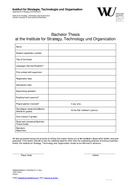
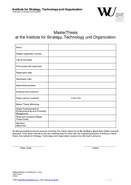
For your support, we have prepared further information on the process and helpful information in the bachelor thesis or master thesis guide. Here, you will also be able to find the registration forms required for the official registration of your thesis.
If you are interested in writing a thesis at our institute, please feel free to contact the potential thesis supervisor from the subject area you are interested in. The best way is to write an email describing your interest in a particular topic or the topic/issue you would like to explore.
Bachelor Thesis (current version, October 2026)

Master Thesis (current version, October 2026)

Institut für Strategie, Technologie und Organisation